
Congress Depends Heavily On Institutional Knowledge
Congressional operations rely on accumulated expertise.
Legislative drafting.
Oversight.
Committee coordination.
Appropriations.
District operations.
Constituent services.
Parliamentary procedure.
These systems require knowledge developed gradually over time through experience inside congressional offices.
Historically, Congress cultivated much of that expertise internally.
Young staff often entered through permanent entry-level positions, developed operational and legislative familiarity, advanced into larger roles, and gradually built long-term institutional continuity inside congressional offices and committees.
That staffing structure helped Congress preserve expertise even as elections changed office leadership.
HillClimbers has also found that institutional knowledge in Congress is increasingly held by staff, especially as staff experience becomes more important to office continuity.
But the structure of that workforce pipeline may now be changing.
<u><strong>Interns have become Congress’s second largest workforce group.</strong></u>
This shift is part of HillClimbers’ broader special report on how interns are becoming infrastructure inside Congress.
Interns have become Congress’s second largest workforce group.
Since 2023, Interns Have Become Congress’s Second Largest Team
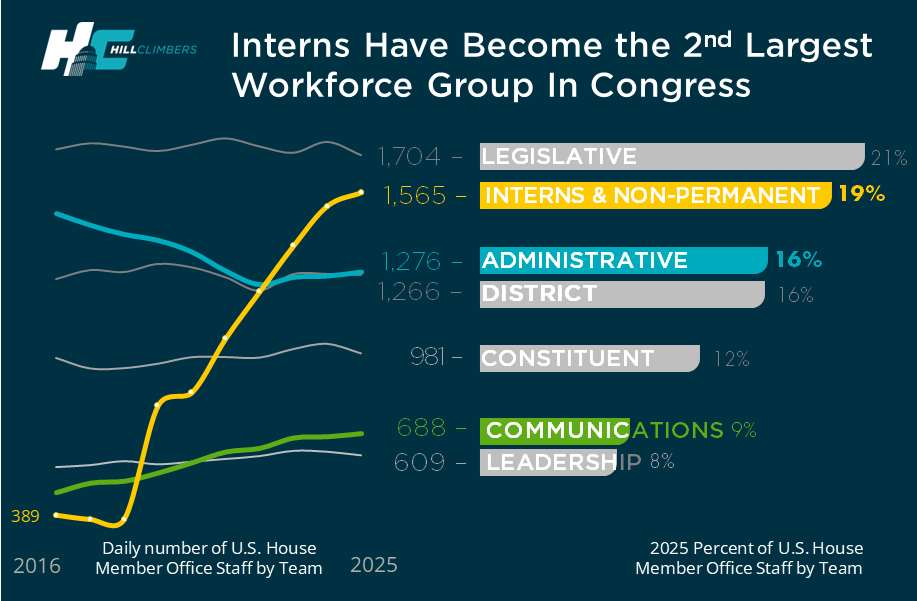
Temporary Staffing Now Represents A Major Share Of Congressional Workforce Capacity
The growth in congressional internship staffing has been dramatic.
Following the creation of a House-paid intern funding initiative in 2019, internship staffing expanded rapidly across congressional offices.
HillClimbers’ related analysis shows that congressional intern staffing increasingly continues year-round, rather than collapsing after the summer cycle.
By 2025:
interns represented approximately 19% of House office staffing capacity
interns surpassed administrative staffing teams in size
interns surpassed district staffing teams in size
interns surpassed constituent service teams in size
interns became Congress’s second largest workforce group behind legislative staff
The scale of the shift is substantial.
HillClimbers also found that House offices now employ roughly one intern for every five staffers during peak periods, showing how large the intern workforce has become relative to permanent staff.
Internships no longer represent a small supplemental educational program operating at the margins of congressional staffing.
Temporary staffing now occupies a major operational role inside congressional offices themselves.
Recent HillClimbers analysis also found that paid congressional intern staffing is rising while average stipends are falling, adding another layer to the intern workforce story.
Congress Historically Built Expertise Through Permanent Workforce Development
For generations, Congress relied heavily on internal workforce progression.
Staff Assistants, Legislative Correspondents, and Legislative Aides frequently developed into:
Legislative Directors
District Directors
Chiefs of Staff
Communications Directors
senior committee staff
Those long-term staffing pathways allowed congressional offices to accumulate operational familiarity and institutional expertise over time.
Permanent staff retained knowledge related to:
legislative procedure
committee systems
constituent operations
district coordination
appropriations processes
office management
Entry-level positions such as Staff Assistant historically helped introduce new staff to front-line communications, administrative support, constituent interaction, and office operations.
For applicants trying to enter that pipeline today, HillClimbers has also found that freshman congressional offices may offer one of the best entry points into Capitol Hill careers.
As temporary staffing expands while several traditional entry-level positions decline, Congress may gradually weaken the workforce pipeline that historically sustained much of that expertise.
HillClimbers’ related analysis shows that traditional congressional entry-level staffing roles have been declining, including positions that historically formed the first rung of the Capitol Hill career ladder.
Congress historically built institutional expertise internally through long-term workforce progression.
Temporary Labor Structures Create Constant Turnover Cycles
Internships remain valuable public service opportunities and continue introducing thousands of students and young professionals to congressional operations.
For students and early-career applicants, HillClimbers has also mapped when to apply for congressional internships as internship opportunities expand beyond the traditional summer cycle.
But internships are temporary by design.
As temporary staffing occupies a larger share of congressional workforce capacity, offices also face constant onboarding and knowledge-transfer cycles.
Every semester, offices must:
recruit new interns
train new workers
transfer operational knowledge
rebuild workflow familiarity
manage repeated transitions
Permanent workforce structures historically minimized much of that turnover internally.
Temporary labor systems operate differently.
HillClimbers analysis shows that since 2009, only approximately 13% of interns ultimately remained in or returned to House employment long term.
That means much of the experience gained through congressional internships leaves Congress entirely after relatively short periods of time.
This is why intern growth matters beyond internships themselves. HillClimbers’ special report explains how interns are becoming infrastructure inside Congress, reshaping how offices maintain capacity under pressure.
Budget Pressure Likely Contributes To The Shift
Many congressional offices face substantial operational pressure.
Modern offices must absorb:
rising labor costs
Washington housing expenses
expanding digital communications demands
retention challenges
growing constituent expectations
constrained office budgets
HillClimbers’ related analysis shows that congressional staffing levels rise and fall based on how much Congress invests in itself, making budget pressure central to understanding office workforce structure.
Internships provide offices with flexibility under those conditions.
Compared with permanent staffing, internships often involve:
lower long-term obligations
semester-based scalability
reduced compensation costs
lower benefit commitments
For offices attempting to maintain operational capacity inside constrained budget systems, temporary staffing structures may offer one of the few scalable workforce tools available.
That pattern also fits HillClimbers’ broader analysis of congressional office size and staffing trends, which shows how House office teams expanded and contracted as budget conditions changed.
But workforce flexibility and institutional continuity are not always the same thing.
Budget pressure can also affect retention. HillClimbers found that lower staff pay is associated with higher congressional staff turnover, adding another challenge for offices trying to preserve experience over time.
Congress’s Workforce Structure Shapes Congress’s Long-Term Capacity
Congressional staffing ultimately determines institutional capability.
The number of experienced legislative professionals inside congressional offices directly affects Congress’s ability to:
process legislation
conduct oversight
retain expertise
sustain policy continuity
manage district operations
operate independently as a co-equal branch of government
HillClimbers has also found that House working days have fallen sharply over the past 50 years, meaning Congress may face capacity pressure in both staffing structure and legislative time.
As internships and temporary staffing continue expanding, Congress may increasingly face difficult long-term tradeoffs between workforce flexibility and institutional continuity.
The full consequences may take years to fully emerge.
But the workforce transformation itself is already visible in the data.
Quietly.
Steadily.
And at significant scale.
Readers can explore related staffing stability, retention, and congressional workforce patterns through the HillClimbers Index.
FAQ Section
Why are congressional internships growing so quickly?
Congressional internships expanded rapidly after the House created a paid intern funding initiative in 2019. The additional funding allowed more offices to hire interns and temporary staff at a much larger scale than in prior decades.
HillClimbers has also found that congressional intern staffing increasingly continues year-round, showing that internship growth is no longer limited to summer.
How large is the congressional intern workforce today?
HillClimbers analysis found that interns represented approximately 19% of House office staffing capacity by 2025, making interns Congress’s second largest workforce group behind legislative staff.
During peak periods, House offices now employ roughly one intern for every five staffers.
Why does congressional institutional knowledge matter?
Institutional knowledge helps congressional offices manage legislative procedure, oversight, constituent services, committee coordination, appropriations, and office operations. Much of this expertise develops gradually through long-term staff experience.
HillClimbers has separately found that institutional knowledge in Congress is increasingly held by staff.
How did Congress traditionally build workforce expertise?
Historically, many congressional staff entered through permanent entry-level roles such as Staff Assistant or Legislative Correspondent and advanced into senior operational and policy positions over time. That internal progression helped preserve institutional continuity inside Congress.
One example is the Staff Assistant, a role that often introduces new staff to front-line communications and office operations.
Are internships replacing permanent congressional staff?
The data suggests temporary staffing has expanded significantly while some traditional permanent entry-level workforce structures appear to be shrinking. However, internship growth does not necessarily mean permanent positions are disappearing entirely.
For more context, HillClimbers’ related analysis shows that traditional congressional entry-level staffing roles have been declining.
Do most congressional interns stay on Capitol Hill long term?
HillClimbers analysis found that only approximately 13% of interns ultimately remained in or returned to long-term House employment after their internship experience.
Why do congressional offices rely heavily on interns?
Internships provide operational flexibility for offices facing constrained budgets, rising labor costs, growing constituent demands, and expanding communications workloads. Temporary staffing structures can scale more easily than permanent hiring.
That budget dynamic is explored further in HillClimbers’ analysis of how congressional staffing levels rise and fall based on how much Congress invests in itself.
Could growing reliance on temporary staff affect Congress long term?
Potentially. As temporary staffing occupies a larger share of congressional workforce capacity, offices may face greater onboarding demands and reduced long-term continuity. The long-term institutional effects may take years to fully emerge.
That is the central concern behind HillClimbers’ special report on how interns are becoming infrastructure inside Congress.
What does congressional workforce structure affect?
Congressional workforce structure influences legislative capacity, oversight capability, institutional continuity, constituent services, policy expertise, and Congress’s ability to operate effectively as a governing institution.
Readers can explore related office stability and workforce indicators through the HillClimbers Index.