
The Staff Keeping the Office Running Are at the Bottom of the Pay Structure
Every congressional office has work that has to happen before almost anything else can happen.
The Member has to get where they need to be.
The schedule has to work.
Visitors and constituents have to be received.
Bills and reimbursements have to be processed.
Technology and office systems have to function.
Records, logistics, supplies, correspondence, travel, and internal workflows all have to be managed.
That is the administrative team.
And through June 30, 2026, it is the lowest-paid of the five major House Member office functions.
The full administrative team averaged:
$67,568.
All House Staff excluding interns averaged $82,006.
That is a $14,438 gap, or 17.6%.
Remove Directors of Operations, the designated functional leaders of the administrative team, and the average falls further:
$64,114.
That is $7,710, or 10.7%, below the $71,824 average for all non-leader House staff.
The people keeping House offices running sit at the bottom of the functional pay structure.
This updates and sharpens the finding from our earlier look at House administrative staff pay. That analysis also placed administrative staff near the bottom of the House salary structure.
The updated methodology now lets us separate the people leading each function from the staff working below them.
For administrative staff, the result is clear under either view.
The House’s Lowest-Paid Team Keeps Offices Running

The Administrative Team Is Not One Kind of Job
Administrative staff can sound like one generic support category.
It is not.
The administrative function includes five core roles:
- Director of Operations
- Executive Assistant/Office Manager
- Scheduler
- Administrative Staff
- Staff Assistant
Those positions cover very different levels of responsibility and experience.
The Director of Operations manages office systems and operations.
Executive Assistants and Office Managers help oversee administrative functions and internal workflow.
Schedulers coordinate one of the office's most time-sensitive functions.
Administrative Staff can include financial administrators, systems administrators, operations staff, and shared employees.
Staff Assistants are usually the most junior members of the administrative team, but their work often extends well beyond the front desk. They may also serve as Legislative Correspondents, support communications work, log constituent requests and casework, help with scheduling, and absorb other administrative responsibilities.
That helps explain why 24.3% of Staff Assistants hold multiple classified roles.
The range matters.
The $64,114 non-leader average is not the salary of one type of employee.
It stretches from a Staff Assistant averaging less than two years of House experience to shared financial and systems administrators averaging more than eight.
Administrative Is the Lowest-Paid Full Function
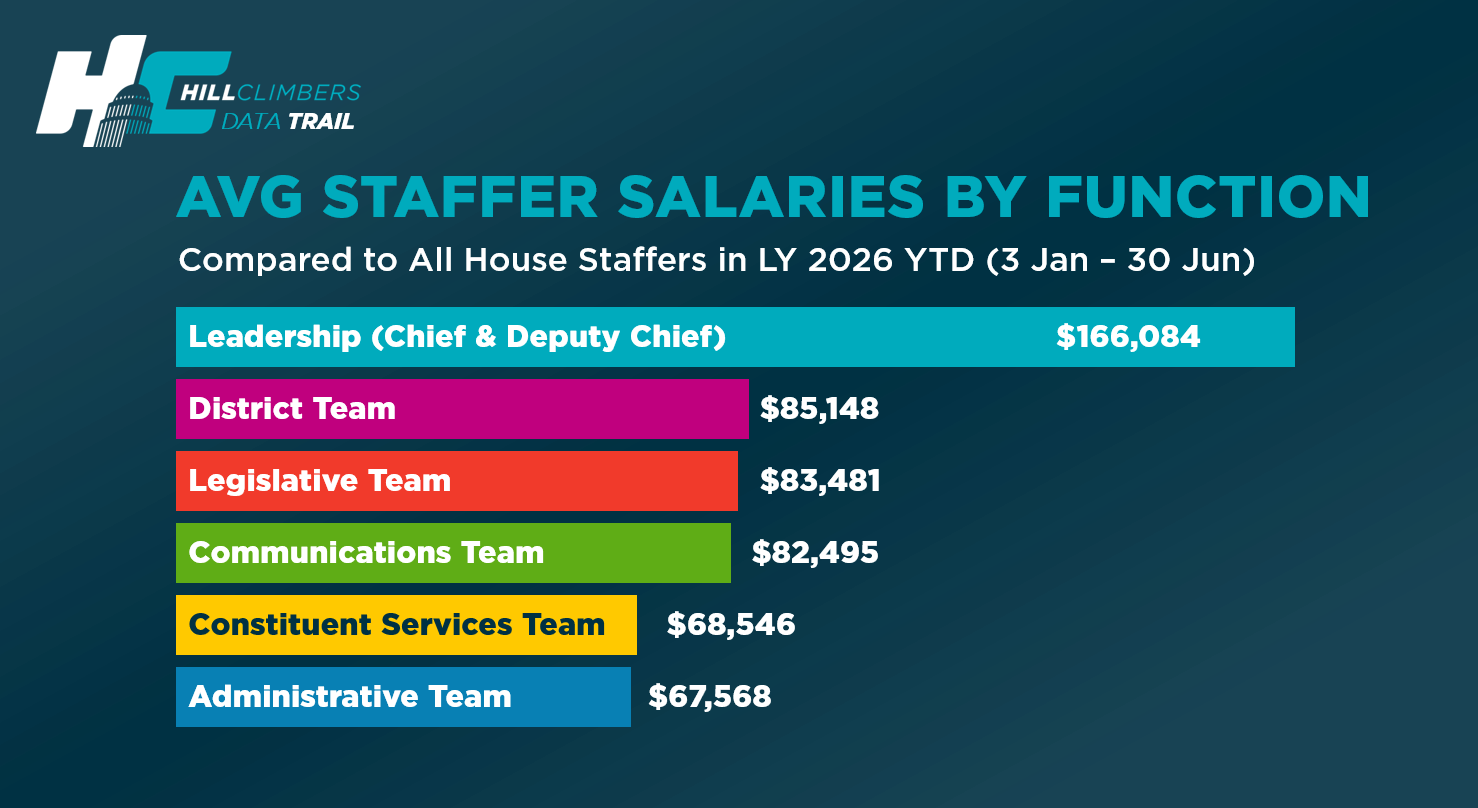
Across all five major Member office functions, Q2 salaries were:
- District: $85,148
- Legislative: $83,481
- Communications: $82,495
- Constituent Services: $68,546
- Administrative: $67,568
Administrative sits at the bottom.
The difference from constituent services is relatively small, just $978.
The gap to the three higher-paid functions is much larger.
Administrative staff average $14,927 less than communications.
$15,913 less than legislative staff.
And $17,580 less than district staff.
Administrative Staff Have the Lowest Full-Team Salary Average
The ranking does not mean every administrative employee earns less than every employee on another team.
Team averages describe workforce structure.
But the structure is clear.
The administrative function occupies the lowest compensation tier in the current House comparison.
Removing Directors of Operations Does Not Change the Ranking
For this Q2 series, we use the same definition of non-leader staff across all five teams.
Chiefs and Deputy Chiefs are treated as leadership.
Each team's functional leader is removed.
Interns, temporary empStaff whose titles explicitly identify them as interns, temporary, or part-time are excluded.loyees, and part-time employees are excluded.
The Statements of Disbursements do not independently identify whether every employee is permanent or non-permanent, so the classification is based on the job title reported in the data.
For administrative staff, that means removing the Director of Operations.
The resulting comparison is:
- Legislative: $75,444
- District: $70,514
- Communications: $66,772
- Constituent Services: $65,198
- Administrative: $64,114
Administrative remains last.
It is $1,084 below constituent services.
$2,658 below communications.
$6,400 below district.
And $11,330 below legislative staff.
Below the Director of Operations Level, Administrative Pay Falls to $64,114
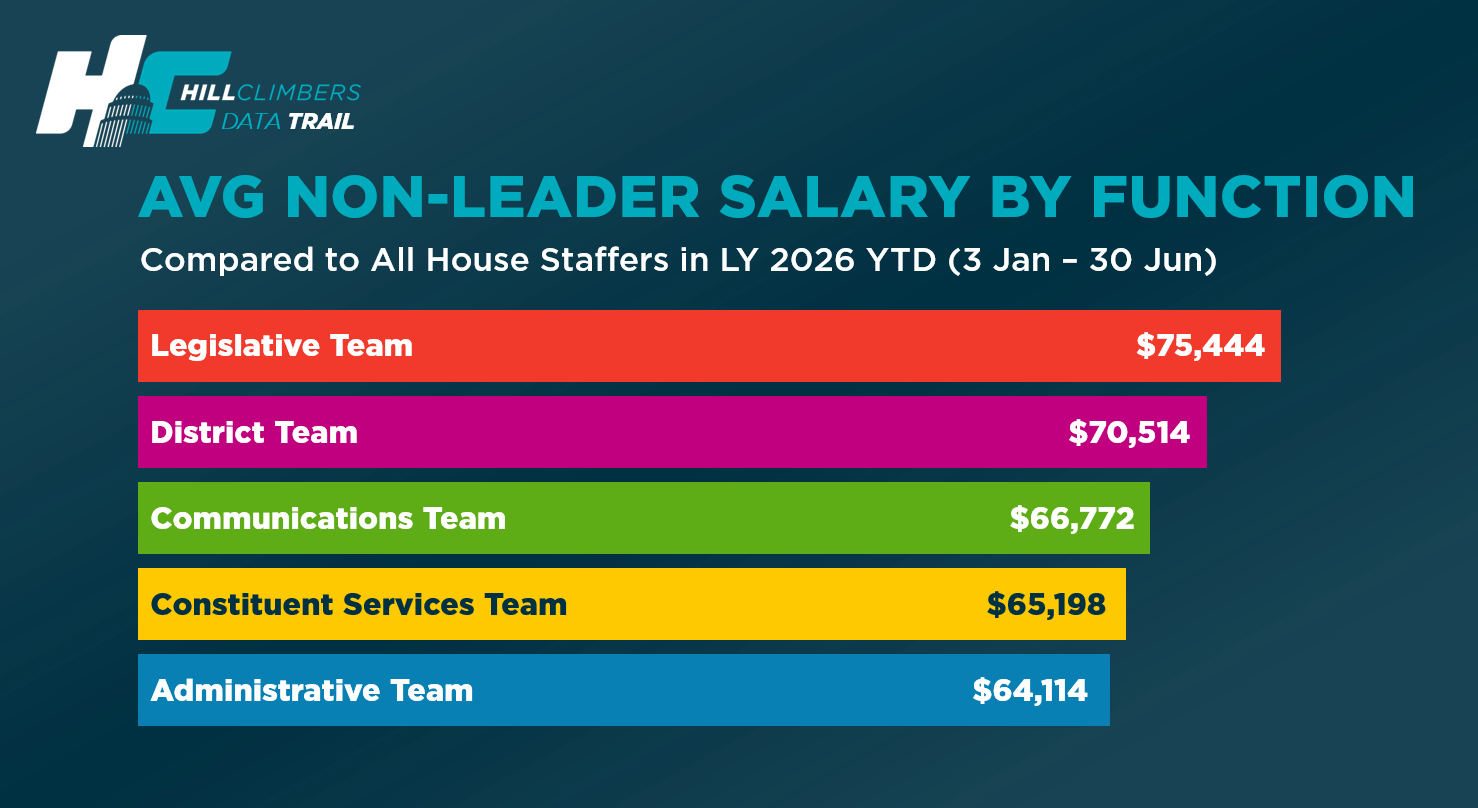
Among House staff below the office and functional-leader level, administrative staff averaged $64,114 through June 30, 2026, the lowest of the five major functions.
Administrative staff rank last whether the functional leaders are included or removed.
That distinguishes administrative staff from teams like district and communications, where removing the functional leader changes the salary picture substantially.
Staff Assistants Are Entry-Level, but Often Not Single-Role
Staff Assistants are the largest administrative role group and one of the House's most important entry points.
The House averaged 643 Staff Assistant role positions per day during the first half of 2026.
Across the period, 897 people held the role.
They averaged just 1.7 years of House experience, consistent with their place near the beginning of the congressional career ladder.
But entry-level should not be confused with narrowly defined.
24.3% of Staff Assistants hold multiple classified roles.
Many also work as Legislative Correspondents, support communications teams, log constituent requests and casework, help with scheduling, or cover other front-office responsibilities.
So while Staff Assistants are often among the least experienced employees in the office, they can also be among the most broadly deployed.
Role turnover had already reached:
39.5% through June 30.
That is a first-half checkpoint, not a final 2026 rate.
Role turnover accumulates as the year progresses, so the final annual number will rise as more employees move out of the role.
Some will leave Congress.
Others will move up.
A Staff Assistant who becomes a Legislative Correspondent, Communications Assistant, Scheduler, or another congressional staffer counts as turnover from the Staff Assistant role even though Congress retained the person.
That is why the number should be read as movement out of the role, not simply attrition from the House.
Congress Has Been Shrinking This Entry-Level Pipeline
The Staff Assistant story matters even more because Congress has been reducing many of the traditional staff positions that historically launched congressional careers.
Our analysis of the decline in permanent entry-level congressional staffing found that Staff Assistant, Legislative Correspondent, and Legislative Aide staffing contracted substantially from 2016 to 2025.
Combined, those traditional non-intern entry-level roles declined by roughly 16%.
At the same time, paid internships expanded rapidly.
That does not mean interns directly replaced specific Staff Assistants.
But the workforce structure has clearly shifted.
Congress now has fewer of some of the traditional junior staff positions that historically allowed employees to enter an office, learn how Congress works, and progress into more experienced roles.
Staff Assistants sit directly inside that story.
They are relatively inexperienced.
They turn over quickly as a role.
Nearly one in four is already helping cover another function.
And they belong to the lowest-paid major team in the House.
Schedulers Are More Experienced, but Nearly Two in Five Carry Another Role
Schedulers look very different from Staff Assistants.
The House averaged 299 Scheduler role positions per day through June 30.
375 people held the role during the period.
They averaged 3.2 years of House experience.
First-half role turnover had reached 25.4%.
But perhaps the most striking number is this:
39.5% of Schedulers hold multiple roles.
Nearly two in five.
That overlap is visible in congressional job titles themselves.
A Scheduler may also be a Director of Operations, Executive Assistant or Office Manager, or Legislative Correspondent/Aide.
The reason is easy to understand.
The Member's schedule touches almost everything the office does.
Operations.
Travel.
Events.
District work.
Policy meetings.
Media.
Stakeholder relationships.
Constituent meetings.
Member time is one of the scarcest resources in a congressional office.
The Scheduler helps decide how that resource gets used.
Yet nearly two in five people performing that function are also carrying another classified responsibility.
That makes scheduling more than an administrative-support story.
It is also an office-capacity story.
Executive Assistants and Office Managers Carry Even More Overlap
The multiple-role rate is even higher among Executive Assistants and Office Managers.
The House averaged 141 Executive Assistant/Office Manager role positions per day during the first half of 2026.
166 people held the role.
They averaged 5.1 years of House experience.
First-half role turnover stood at 18.6%.
And:
42.9% held multiple roles.
That is nearly half of the workforce in the category.
These employees are not inexperienced.
At 5.1 years of average House experience, they often bring substantial knowledge of the office, its systems, its Member, and its internal workflow.
Their work can overlap with scheduling, operations, constituent service, field work, and executive support.
The administrative team is low paid, but much of its work is neither junior nor narrowly administrative.
That distinction matters.
Administrative compensation is not simply a story about entry-level Staff Assistants.
It also includes experienced employees combining several operational responsibilities at once.
Directors of Operations Are Experienced Too, and One in Four Carries Another Role
At the top of the function sit Directors of Operations.
The House averaged 193 Director of Operations role positions per day through June 30.
Across the period, 233 people held the role.
They averaged 4.5 years of House experience.
First-half role turnover had reached 21.4%.
And 25.0% held multiple roles.
Directors of Operations help manage the systems that allow an office to function: administrative processes, internal operations, staffing procedures, financial workflows, technology, logistics, and compliance.
The role is removed from the $64,114 non-leader calculation because it is the administrative team's designated functional leader.
But Directors of Operations remain part of the broader $67,568 full-team average.
That is worth noting.
Even after including the team's functional leaders, administrative staff still have the lowest average salary of the five major functions.
Administrative Staff Are a Different Kind of Workforce
Then there is the category simply called Administrative Staff.
It looks unlike any other role on the administrative team.
The House averaged 176 Administrative Staff role positions per day during the first half of 2026.
The role-view data recorded 791 staff entries holding the category during the period.
But that figure requires caution because many of these employees work across more than one Member office.
Average House experience was:
8.3 years.
And:
44.9% were shared among offices.
The category includes financial administrators, shared financial administrators, systems administrators, technical staff, operations personnel, and other specialized administrative employees.
These are often highly experienced House professionals.
And many operate differently from a conventional employee assigned to one Member office.
That distinction becomes critical when we look at turnover.
The 349.4% Administrative Staff Turnover Figure Is Not a Useful Churn Measure
The raw role-turnover calculation for Administrative Staff is:
349.4%.
We should not interpret that as conventional employee turnover.
The reason is the workforce structure.
A shared financial or systems administrator can support several offices.
During the year, that employee may add an office.
Drop an office.
Replace one office with another.
Or change the mix of offices they support.
The employee may still be working in the House, doing essentially the same job, while the role-office relationships underneath them change repeatedly.
That makes the turnover calculation behave very differently than it does for a Staff Assistant, Scheduler, or Director of Operations.
For this role, the more useful measures are:
8.3 years of average House experience.
44.9% shared among offices.
Those numbers tell us much more about the workforce than the raw turnover percentage does.
Shared Administrative Staff Are Part of Congressional Infrastructure
Nearly half of the Administrative Staff category is shared across offices.
That can be an efficient staffing model.
An individual Member office may not need a full-time financial administrator or systems specialist.
Sharing one experienced professional across multiple offices can give Members access to expertise that would otherwise be difficult to maintain independently.
But it also means part of the House's administrative capacity rests on a relatively specialized workforce serving several offices at once.
At 8.3 years of House experience, Administrative Staff average far more congressional experience than Staff Assistants, Schedulers, Directors of Operations, or Executive Assistants and Office Managers.
That experience can include deep familiarity with financial procedures, reimbursement systems, technology, records, procurement, payroll, compliance, and internal House operations.
Those functions rarely receive the same public attention as legislation, communications, or constituent casework.
An office still cannot operate without them.
Role Turnover Means Something Different From Office Turnover
For the four more conventional administrative role groups, turnover through June 30 had already reached:
- Executive Assistant/Office Manager: 18.6%
- Director of Operations: 21.4%
- Scheduler: 25.4%
- Staff Assistant: 39.5%
These are role-based turnover rates.
They do not mean the employee necessarily left Congress.
A Staff Assistant promoted to Legislative Correspondent counts as turnover from the Staff Assistant role.
A Scheduler who becomes an Executive Assistant counts as turnover from scheduling.
Someone leaving the House entirely also counts.
But someone who changes Member offices and remains in the same classified role does not count as role turnover.
And as discussed above, the shared Administrative Staff category has an additional complication because office assignments themselves change frequently.
These figures also cover only the first half of 2026.
They are checkpoints, not final annual turnover rates.
That makes this role analysis different from office-level tools like the HillClimbers Index, which looks at the capacity, stability, and structure of an entire Member office.
The role view asks how people move through particular jobs.
The office view asks what those movements mean for the team as a whole.
Multiple Roles Are Built Into the Administrative Function
Across most of the administrative team, carrying more than one responsibility is common.
25.0% of Directors of Operations hold multiple roles.
42.9% of Executive Assistants/Office Managers do.
39.5% of Schedulers do.
24.3% of Staff Assistants do.
That is striking when compared with the broader House workforce.
Our 2026 analysis of multiple-role staffing found that 8.2% of Member office staff held multiple classified roles, the highest share in the historical office-view series.
The figures are not directly identical measures. The House-wide number uses the office-view, person-level methodology, while the administrative percentages here examine people occupying individual role categories.
But the concentration is hard to miss.
Administrative jobs are frequently being combined with other work.
Some of that is logical.
A Scheduler may also serve as an Executive Assistant.
A Staff Assistant may also handle legislative correspondence, communications work, or constituent intake.
An Office Manager may also manage scheduling.
A Director of Operations may hold another senior portfolio.
In a small congressional office, combinations like these can be useful.
But sustained reliance on combined jobs also tells us something about how offices stretch limited staff capacity.
Staff Assistants Show Why Headcount Alone Can Be Misleading
Consider the Staff Assistant.
One employee counts as one person in the office.
But that person may answer phones and greet visitors.
They may also process constituent correspondence.
They may log new casework.
They may draft or route legislative responses.
They may support the communications team.
They may help the Scheduler.
They may absorb whatever work has to be covered when another position is vacant.
Headcount sees one employee.
The office experiences several functions being supported by that employee.
That is precisely why the distinction between person-level staffing and role-level analysis matters.
Our Q2 staffing methodology counts a person once when measuring how many people are working in the office, while still allowing the role analysis to capture the different jobs reflected in their title.
Both views are necessary.
One tells us how many people Congress has.
The other helps show how much those people are being asked to cover.
Low Administrative Pay Is a Capacity Issue
Administrative work can be easy to treat as overhead.
In a congressional office, it is infrastructure.
A Member cannot be in two places at once without a Scheduler helping determine which place matters more.
Legislative and communications staff cannot focus entirely on their work if basic office systems are not functioning.
A district office cannot serve constituents effectively if intake and front-office processes break down.
Public money cannot be managed responsibly without people who understand House financial systems.
An office cannot preserve institutional knowledge if core operational processes have to be relearned every time a junior employee moves on.
The administrative function enables every other function.
That is why its position at the bottom of the salary structure matters beyond compensation.
When administrative capacity weakens, the work does not disappear. It moves somewhere else in the office.
That may mean another staffer picks it up.
A Scheduler also becomes an Office Manager.
A Staff Assistant absorbs communications or legislative work.
A Director of Operations takes on an additional portfolio.
Or an office relies more heavily on shared staff.
The office can still look staffed on paper while specialization erodes underneath the headcount.
The Pay Finding Extends an Earlier Warning
Administrative compensation was already showing signs of pressure before this Q2 update.
Our analysis of 2025 administrative staff salaries found the largest salary decline among the major House staff groupings that year.
The updated Q2 methodology is different, so those figures should not be connected into a precise year-over-year trend line.
But the newer data does not reverse the broader concern.
Administrative staff remain at the bottom of the House compensation structure.
The earlier administrative team analysis placed the team at $70,991 and second-lowest under the methodology used at the time.
The standardized Q2 calculation puts the full team at $67,568 and the non-leader population at $64,114.
The numerical difference should not be treated as a clean salary decline because the methodology changed.
The structural position is the clearer finding.
Flat Budgets Give Offices Less Room to Fix the Problem
Administrative staff are also operating inside the broader budget pressure affecting the House workforce.
A Member office has one constrained operating allowance supporting salaries alongside district rent, travel, technology, official communications, supplies, and other expenses.
Our analysis of Q1 Member office spending found average office spending fell 11.5% from 2025 Q1 to 2026 Q1.
Personnel spending fell 3.3%.
Non-personnel spending fell 30.3%.
Offices appear to have cut much more aggressively outside payroll, which is consistent with trying to protect staff where possible.
But personnel spending still fell.
The Q2 staffing update showed the staffing pressure continuing through June.
That matters for administrative capacity.
A flat nominal budget does not freeze salaries, rent, travel, technology, or other costs.
As those costs rise, offices have less room to add staff, specialize jobs, or increase compensation.
For a team where multiple-role staffing is already common, that can mean continuing to spread necessary work across the employees who remain.
Why $67,568 Should Not Be Compared Directly With $70,991
The previous administrative salary article reported a $70,991 team average using LY 2025 YTD data.
The Q2 2026 figure is $67,568.
That is a numerical difference of $3,423.
It is not a clean measure of salary decline.
The methodology has changed.
The updated series uses the revised person-level approach for House-wide measures and a standardized definition of non-leader staff.
Chiefs and Deputy Chiefs are classified as leadership.
Each team's functional leader is removed from the non-leader comparison.
Staff whose titles explicitly identify them as interns, temporary, or part-time are excluded.
And the team being analyzed remains inside the common $71,824 All Non-Leader Staff benchmark.
That gives the legislative, district, communications, constituent services, and administrative articles the same comparison point.
The Q2 figures should therefore be the benchmark going forward.
The Administrative Team Shows Why One Salary Average Is Not Enough
This five-part series began with a basic question:
How does pay differ across the major functions inside a House Member office?
Administrative staff may provide the clearest example of why the answer cannot stop at one team average.
The full administrative team averages $67,568.
Non-leaders average $64,114.
But underneath those numbers are very different workforces.
A Staff Assistant averaging 1.7 years of experience, with 24.3% carrying multiple roles and 39.5% first-half role turnover.
A Scheduler averaging 3.2 years of experience, with 39.5% carrying multiple roles.
An Executive Assistant/Office Manager averaging 5.1 years of experience, with 42.9% carrying multiple roles.
A Director of Operations averaging 4.5 years of experience, with one in four carrying another classified role.
And an Administrative Staff category averaging 8.3 years of House experience, with nearly half shared across offices.
They all belong to the administrative function.
They do not represent the same kind of congressional job.
The common thread is that they provide the operational infrastructure that allows every other team to function.
And through Q2 2026, that infrastructure sits at the bottom of the House salary structure.
This Completes the Five-Part Q2 Salary Series
With administrative staff, we have now examined all five major Member office functions under one standardized Q2 salary methodology.
The non-leader averages are:
- Legislative: $75,444
- District: $70,514
- Communications: $66,772
- Constituent Services: $65,198
- Administrative: $64,114
The series shows there is no single congressional staff salary story.
Each function has a different combination of compensation, experience, career movement, multiple-role staffing, and organizational structure.
Legislative staff lead non-leader pay.
District staff have a deeply experienced leadership layer.
Communications is growing, but much of its junior workforce remains relatively low paid and fluid.
Constituent services combines years of experience with high levels of multiple-role work.
Administrative staff sit at the bottom of the pay structure while carrying much of the infrastructure that allows all four of those teams to operate.
The next step is to bring those findings together.
The five articles now give us a common framework for examining how a House Member office distributes not just its payroll, but its workforce capacity.
FAQ
How much do House administrative staff make in 2026?
The full administrative team averaged $67,568 through June 30, 2026. Administrative staff below the Director of Operations level averaged $64,114.
Are administrative staff the lowest-paid House team?
Yes, in the Q2 2026 comparison. Administrative staff had the lowest average among the five full functional teams at $67,568 and the lowest non-leader average at $64,114.
How does administrative pay compare with other non-leader teams?
Non-leader administrative staff averaged $64,114, compared with $65,198 for constituent services, $66,772 for communications, $70,514 for district, and $75,444 for legislative staff.
What roles are included in the House administrative team?
The administrative team includes Directors of Operations, Executive Assistants/Office Managers, Schedulers, Administrative Staff, and Staff Assistants.
How experienced are congressional Staff Assistants?
Staff Assistants averaged 1.7 years of House experience through June 30, 2026.
What is Staff Assistant turnover?
Role turnover had already reached 39.5% through the first half of 2026. That includes people promoted or moving into other classified roles as well as those leaving the House, and it is not a final annual rate.
How experienced are congressional Schedulers?
Schedulers averaged 3.2 years of House experience.
How many Schedulers hold multiple roles?
39.5% of Schedulers hold multiple classified roles.
How experienced are Executive Assistants and Office Managers?
Executive Assistants/Office Managers averaged 5.1 years of House experience.
How many Executive Assistants and Office Managers hold multiple roles?
42.9% hold multiple classified roles, the highest share among the conventional administrative role groups in this analysis.
How experienced are Directors of Operations?
Directors of Operations averaged 4.5 years of House experience.
What are shared Administrative Staff?
The Administrative Staff category includes financial administrators, systems administrators, shared staff, operations personnel, and other specialized administrative employees. 44.9% are shared among multiple offices.
Why is Administrative Staff turnover listed above 300%?
The raw 349.4% measure should not be interpreted as conventional employee turnover. Many Administrative Staff are shared across Member offices and frequently add, drop, or change office assignments. Those movements distort a role-office turnover calculation even when the employee continues doing essentially the same job. HillClimbers therefore does not use the figure as a meaningful measure of workforce churn.
How experienced are Administrative Staff?
The category averages 8.3 years of House experience, the highest experience level among the five administrative role groups.
Where can I find congressional administrative jobs?
Current openings are available on the HillClimbers Congressional Jobs Board, with additional information available through HillClimbers' Member Office Roles pages.
Suggested Reading
House Administrative Staff Salaries Sit Near the Bottom of the Team Pay Scale
Administrative Staff Saw the Sharpest Pay Decline in House Offices During 2025
District Staff Lead House Pay, but Non-Leaders Average $70,514
The Comms Team Is Growing, but Non-Leader Pay Averages Just $66,772
The House Staff that Constituents Rely On Average $65,198
How Congress Quietly Replaced Part of Its Entry-Level Workforce
Institutional Knowledge in Congress Is Increasingly Held by Staff
More House Staff Are Wearing Multiple Hats
Explore Related HillClimbers Tools
Executive Assistant/Office Manager
Explore Congressional Staffing Data
Learn How Congressional Staffing Works
Explore the HillClimbers Index
View Current Congressional Jobs