
More House Staff Are Wearing Multiple Hats
More House staff are carrying more than one role.
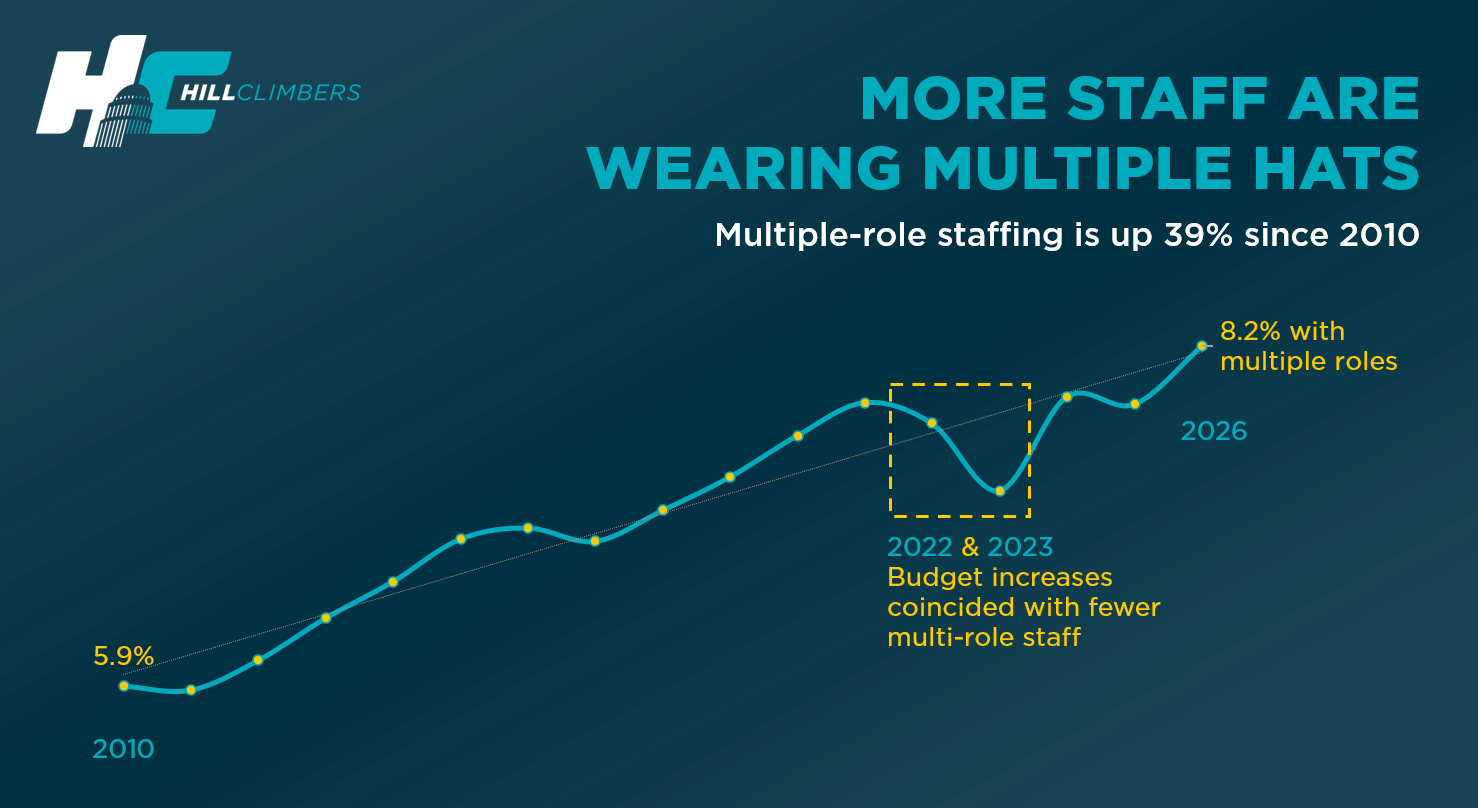
HillClimbers’ office-view analysis shows that the share of House Member office staff with multiple roles rose from 5.9% in 2010 to 8.2% in 2026. That is the highest level in the series.
It is also a 38.8% increase in the multi-role staffing share since 2010.
The count moved too. In 2010, House offices had about 471 daily staff with multiple roles. By 2026, that number had risen to about 602 daily multi-role staff.
That increase happened even though total daily staff fell from about 7,959 in 2010 to 7,335 in 2026.
That is the real warning sign.
The House is not simply adding more staff and seeing more people with blended responsibilities as a byproduct. Instead, a larger share of a smaller workforce appears to be carrying multiple functions.
The House is not just asking staff to do more work. It is increasingly asking more staff to span more functions.
More Staff Are Wearing Multiple Hats
What HillClimbers Means by Multiple Roles
This analysis uses HillClimbers’ office-view data.
That matters.
HillClimbers classifies each staffer with a primary role and, when the staffer’s title clearly reflects more than one function, an optional secondary role. For example, a title such as “Deputy Chief of Staff and Communications Director” or “Field Representative/Caseworker” can reflect multiple distinct office functions.
This person-level method is different from a role-view analysis.
A role-view analysis can be useful for understanding how role categories overlap, but it can also count the same person in more than one category. A staffer whose title maps to both Communications Staff and Staff Assistant may appear in both role groupings.
This office-view analysis asks a cleaner question:
Out of all daily staff in Member offices, how many individual staffers appear to be carrying more than one role?
That is why the newer number is lower than some earlier role-view estimates. It is also more precise for measuring the share of people who are actually wearing multiple hats.
The Long-Term Trend Is Up
The trend is not subtle.
In 2010, about 5.9% of House Member office staff had multiple roles. By 2015, that figure had risen to 6.9%. By 2020, it reached 7.6%. By 2026, it reached 8.2%.
That may sound small in percentage-point terms. It is not small operationally.
In a House workforce of more than 7,000 daily staff, a move from 5.9% to 8.2% means hundreds of people are now classified as carrying multiple roles.
In 2026, about 1 in 12 House staffers had multiple roles. In 2010, it was closer to 1 in 17.
That is a meaningful change in how offices appear to be structured.
Congressional offices have always required flexibility. Staff often help outside their formal job descriptions. A Staff Assistant may support tours, phones, mail, scheduling, and correspondence. A Legislative Correspondent/Aide may help with legislative research and constituent response. A Field Representative may cover outreach, casework coordination, and district events.
But a rising multi-role share suggests something more structural.
More titles now appear to combine functions that, in a larger or less constrained office, might be separated.
The 2022 and 2023 Dip Matters
The long-term trend is upward, but it does not rise every year.
The most important interruption came in 2022 and 2023.
The share of House staff with multiple roles was 7.8% in 2021. It dipped to 7.7% in 2022, then fell more clearly to 7.2% in 2023.
That timing matters.
In 2022, House Member Representational Allowances increased significantly across the board. In 2023, the Clerk Hire portion of the MRA increased substantially again, giving offices more dedicated payroll capacity even as other categories were adjusted.
The multi-role trend moved in the opposite direction during that period.
That does not prove that budget increases alone caused the decline. Office staffing patterns can change for many reasons, including turnover, hiring timing, title practices, Member transitions, and shifts in office structure.
But the pattern is important.
When offices received meaningful budget relief, the share of staff carrying multiple roles declined. When budget pressure returned, the multi-role share climbed again, reaching 8.2% in 2026, the highest level in the series.
Budget relief appears to have given offices more room to specialize. As the pressure returned, so did the multi-role trend.
That makes multi-role staffing a useful capacity signal. It may show when offices have enough room to separate responsibilities and when they are forced to spread work across fewer people.
Multi-Role Staffing by Year
The year-by-year data shows how the pattern developed.
Two comparisons stand out.
First, the share of staff with multiple roles rose from 5.9% in 2010 to 8.2% in 2026.
Second, the 2026 multi-role count is higher than 2011 even though the overall staff count is much lower. In 2011, House offices had about 9,126 daily staff and 537 daily multi-role staff. In 2026, they had about 7,335 daily staff and 602 daily multi-role staff.
That means House offices had about 1,792 fewer daily staff than in 2011, but about 65 more daily multi-role staff.
That is a hidden capacity story.
Multiple Roles Can Mean Flexibility or Strain
Multiple-role staffing is not automatically bad.
In some offices, it can reflect smart design. A district staffer may naturally combine outreach and casework. A communications staffer may also handle digital content. A senior staffer may bridge policy and operations. A smaller office may intentionally use flexible roles because the Member’s priorities or district needs call for it.
But when the share rises across the institution over time, it deserves attention.
Multi-role staffing can also signal strain.
It can mean offices are covering more functions without adding enough specialized positions. It can mean staff are stretched across responsibilities that would ideally be separated. It can mean a single departure creates a larger operational gap because one person was covering multiple areas.
That matters because a Member office is not one job. It is a small organization with many different functions.
HillClimbers’ Member Office Roles page shows how those functions fit together across leadership, legislative, communications, constituent services, district, administrative, and intern roles.
When more staff carry multiple roles, the office may gain flexibility. It may also lose redundancy, specialization, and stability.
The Trend Fits the Broader Capacity Story
The rise in multi-role staffing fits a broader pattern HillClimbers has been tracking.
House offices are facing budget pressure, pay pressure, staffing pressure, and operational strain.
HillClimbers recently found that flat budgets do not mean flat staffing levels. Staffing excluding interns declined from the beginning of February to the end of March in the second session of the 119th Congress.
HillClimbers also found that House offices are running out of things to cut, with 2026 Q1 spending falling across both personnel and non-personnel categories.
Another analysis found that administrative staff are losing ground while leadership pay keeps rising, showing that pay pressure is not landing evenly across the office.
This article adds another layer: more staff appear to be spanning multiple roles.
Together, the pattern suggests that offices are not only managing with constrained budgets. They may also be reorganizing work inside the office, asking more people to cover more than one function.
That is why multiple-role staffing matters.
It is not just a title detail.
It is a signal of how stretched the office may be.
Why Administrative and Entry-Level Roles Matter Here
Multi-role staffing often becomes visible near the operating core of the office.
A Staff Assistant may be asked to support front office coverage, constituent correspondence, tours, administrative tasks, and scheduling support. An Administrative Staff role may overlap with operations, office management, and constituent-facing support. A Scheduler may carry logistics, executive support, and administrative responsibilities.
Those roles are essential.
They are also the roles most likely to reveal whether an office has enough operational capacity.
HillClimbers has previously shown that Congress quietly replaced part of its entry-level workforce. As traditional entry-level roles shrink or change, offices may rely more on blended responsibilities, interns, temporary staff, or staff who span multiple functions.
That has consequences for career pathways.
If early-career staff are asked to cover several roles at once, they may gain broad exposure. But they may also face unclear expectations, heavier workloads, and fewer clean development paths.
The same pattern matters for constituent service and district operations. A Constituent Services Representative/Caseworker, Field Representative, or District Director may carry responsibilities that cross casework, outreach, events, and local relationship management.
When those responsibilities stack, the office may still function. But the strain becomes harder to see from the outside.
Why This Matters for Job Seekers
For Capitol Hill job seekers, multiple-role staffing is important because job titles do not always tell the full story.
A title can look simple. The actual job may span several functions.
That is not always a bad thing. Some staffers want broad responsibility. A hybrid role can offer faster learning, more visibility, and more varied experience.
But applicants should understand what they are walking into.
A candidate considering a House office job should ask:
- What are the main responsibilities of this role?
- Are there secondary responsibilities not reflected in the title?
- Is this position replacing one person or covering work previously handled by several people?
- How many staff are on the team?
- Who supervises the role?
- What happens when workload spikes?
- Is there room to specialize over time?
HillClimbers’ congressional jobs board helps applicants find current openings. The HillClimbers Index helps them evaluate office capacity, stability, and structure.
The multiple-role trend adds another question: how many hats are staff being asked to wear?
Why This Matters for Journalists and Researchers
For journalists and researchers, multi-role staffing offers a way to see hidden institutional pressure.
Headcount alone does not show how work is distributed.
Two offices can have the same number of staff but very different internal structures. One may have specialized legislative, communications, district, casework, and administrative teams. Another may rely on staff who span several of those areas at once.
Both offices may appear similar in raw staffing levels.
They are not operationally identical.
That is why HillClimbers’ congressional staffing data looks beyond headcount. Staff pay, turnover, intern levels, promotions, experience depth, structure, and multiple-role load all help explain how offices function.
A rise in multi-role staffing should raise several research questions:
- Are offices becoming less specialized?
- Are budget constraints pushing offices toward hybrid positions?
- Are newer staff absorbing more cross-functional work?
- Are district and administrative roles carrying more blended responsibilities?
- Does multi-role staffing predict turnover or salary pressure?
- Did budget relief in 2022 and 2023 temporarily reduce the need for blended roles?
Those are the kinds of questions that basic headcount data cannot answer.
The Budget Lesson
The 2022 and 2023 dip may be the most important part of the chart.
It suggests that budget relief may have given offices room to staff more normally.
When the MRA increased in 2022 and Clerk Hire increased substantially in 2023, offices had more room to pay staff and support permanent workforce capacity. During that same period, the share of staff with multiple roles declined from 7.8% in 2021 to 7.2% in 2023.
Then the trend reversed.
By 2024, the multi-role share was back up to 7.9%. In 2025, it remained elevated at 7.8%. In 2026, it reached 8.2%.
That pattern should matter to anyone involved in congressional modernization or legislative branch funding.
Budgets do not just affect salaries. They affect the shape of the office.
When offices have more room, they may be able to separate functions, hire more specialized staff, and reduce the number of people carrying multiple roles. When pressure returns, offices may stretch staff across more responsibilities.
The budget does not just determine how much staff are paid. It helps determine how many jobs one staffer has to do.
That is why multi-role staffing belongs in the larger conversation about congressional capacity.
What the Data Really Shows
The clearest finding is simple: more House staff are wearing multiple hats.
The share of Member office staff with multiple roles rose from 5.9% in 2010 to 8.2% in 2026. That is a 38.8% increase.
The number of daily multi-role staff rose from about 471 to 602 over the same period.
And the trend reached a new high in 2026.
But the more important insight is not just that the line went up. It is that the line dipped when offices received meaningful budget relief, then climbed again when pressure returned.
That suggests multi-role staffing may be one of the clearest hidden indicators of congressional capacity.
When offices have enough resources, more staff may be able to specialize. When budgets tighten, more staff may be asked to span functions.
That does not mean every multi-role position is a problem. Some hybrid jobs are useful, intentional, and valuable.
But when multi-role staffing rises across the institution, it should be treated as a signal.
The House does not just need enough staff.
It needs enough staff with enough room to do their jobs well.
FAQ
Are more House staff carrying multiple roles?
Yes. HillClimbers’ office-view data shows that the share of House Member office staff with multiple roles rose from 5.9% in 2010 to 8.2% in 2026.
How much has multiple-role staffing increased since 2010?
The share of House staff with multiple roles increased by 38.8% from 2010 to 2026.
What share of House staff have multiple roles in 2026?
In 2026, 8.2% of House Member office staff had multiple roles in HillClimbers’ office-view data.
How many House staff have multiple roles?
In 2026, House offices had about 602 daily staff with multiple roles, up from about 471 in 2010.
What does “multiple roles” mean?
In this analysis, multiple roles means a staffer has a title or role structure that clearly reflects more than one function. HillClimbers classifies each staffer with a primary role and, when the title supports it, an optional secondary role.
Why is this method different from earlier role-view analysis?
Earlier role-view analysis looked at role categories and could count the same person in more than one role grouping. This office-view analysis counts people, making it better suited to measuring how many individual staffers are carrying multiple roles.
Did budget increases reduce multiple-role staffing?
The data does not prove causation, but significant budget relief in 2022 and 2023 coincided with a decline in the share of staff carrying multiple roles. The multi-role share fell from 7.8% in 2021 to 7.2% in 2023, then rose again to 8.2% in 2026.
Is multi-role staffing bad?
Not always. Some hybrid roles are intentional and useful. But a sustained rise in multi-role staffing can signal that offices are stretching staff across more functions because they lack enough capacity to specialize.
Why does multi-role staffing matter?
Multi-role staffing matters because it shows how work is organized inside House offices. If more staff are carrying multiple functions, offices may have less specialization, less redundancy, and more hidden workload pressure.
How does this affect congressional job seekers?
Job seekers should understand that a title may not capture the full job. A role may include secondary responsibilities across scheduling, correspondence, communications, casework, legislative work, administration, or district operations. Applicants should ask what responsibilities are actually attached to the position.
Suggested Reading
- Flat Budgets Don’t Mean Flat Staffing Levels
- House Offices Are Running Out of Things to Cut
- Administrative Staff Are Losing Ground While Leadership Pay Keeps Rising
- How Congress Quietly Replaced Part of Its Entry-Level Workforce
- Congressional Intern Staffing Now Stays Elevated Year-Round
- When Interns Become Infrastructure
- Congressional Institutional Memory
Explore Related HillClimbers Tools
- Explore congressional staffing data
- Explore the HillClimbers Index
- Explore Member office roles
- Learn how congressional staffing works
- View current congressional jobs
- Explore the Staff Assistant role
- Explore the Administrative Staff role
- Explore the Field Representative role
- Explore the Constituent Services Representative/Caseworker role