
The 2026 Q1 Data Shows the Squeeze Getting Worse
House offices are not just trimming around the edges.
The newest HillClimbers analysis of Member Representational Allowance spending shows that average House Member office spending fell sharply from 2025 Q1 to 2026 Q1.
Average Q1 spending declined from $486,924 in 2025 Q1 to $430,825 in 2026 Q1. That is a drop of $56,099 per office, or 11.5%.
The decline was not limited to one category. Average personnel spending fell. Average non-personnel spending fell much more. Offices appear to be cutting operating costs aggressively, but the cuts are no longer enough to fully protect payroll.
That is the core problem.
We are no longer looking at offices trimming around payroll. We are looking at offices cutting around payroll and still spending less on staff.
Average Q1 Spend Fell Sharply in 2026

The MRA Is Built From Buckets, But Offices Spend From One Pot
Congress often tells agencies, grantees, and programs to spend money only for specific purposes. A dollar appropriated for one purpose is not always available for another.
Member offices operate differently.
Each House Member receives a Member Representational Allowance, or MRA, that is calculated through several components: Clerk Hire, travel, district office rent, official office expenses, and official mail. But once the MRA is set, offices generally manage one total operating budget.
That means a Member office can make tradeoffs across categories. It can spend more on staff and less on travel. It can limit mail to preserve payroll. It can delay equipment purchases to protect salaries. In an extreme example, an office could spend nearly all of its available budget on staff and very little on travel, equipment, district operations, or official mail.
That flexibility is useful. It is also the problem.
When budgets are growing, flexibility helps offices adapt. When budgets flatten, flexibility turns into a series of tradeoffs.
HillClimbers’ explainer on how congressional staffing works provides the broader context on House staffing limits, the MRA, and the structure of Member office budgets.
The key point is simple: House offices may have several spending categories, but they are managing one constrained operating budget.
The Q1 Decline Was Mostly a Non-Personnel Collapse
From 2025 Q1 to 2026 Q1, average Clerk Hire spending fell from $338,878 to $327,707.
That is a decline of $11,171 per office, or 3.3%.
That matters because Clerk Hire is the personnel component of the MRA. It is the money used to pay the staff who run legislative, district, communications, administrative, constituent-service, and leadership operations.
But the larger decline came from non-personnel spending.
Average Q1 non-personnel spending fell from $148,046 in 2025 Q1 to $103,119 in 2026 Q1. That is a decline of $44,927 per office, or 30.3%.
Put differently: offices cut nearly one-third of their Q1 non-personnel spending and still spent less on personnel.
That is the “Robbing Peter to Pay Paul” problem. Offices can cut around payroll for a while, but the surrounding office infrastructure is not unlimited. Eventually, the pressure reaches both sides of the budget.
Q1 Spending by Category
The Q1 category-level data shows where the pressure landed.
Category2025 Q12026 Q1ChangePercent ChangeClerk Hire$338,878$327,707-$11,171-3.3%District Office Rent$20,359$20,030-$329-1.6%Office Expenses$65,005$59,084-$5,920-9.1%Official Mail$41,722$10,738-$30,984-74.3%Travel$20,960$13,266-$7,694-36.7%Overall$486,924$430,825-$56,099-11.5%
Official Mail saw the sharpest Q1 decline, falling from $41,722 to $10,738. Travel also fell sharply, from $20,960 to $13,266. Office expenses declined from $65,005 to $59,084. District office rent was relatively stable.
The pattern is clear. Offices cut most sharply from categories with more short-term flexibility.
But those categories are not luxuries.
Official mail supports constituent communication. Travel supports district presence. Office expenses support equipment, technology, supplies, and daily operations. District office rent supports physical access to the Member’s office outside Washington.
Cutting these costs may preserve payroll temporarily. It also reduces the operating capacity around the staff.
Flat budgets do not freeze costs. They force offices to choose which capacity to lose first.
The Annual Data Shows This Started Before 2026
The Q1 data is the freshest signal, but it is not isolated.
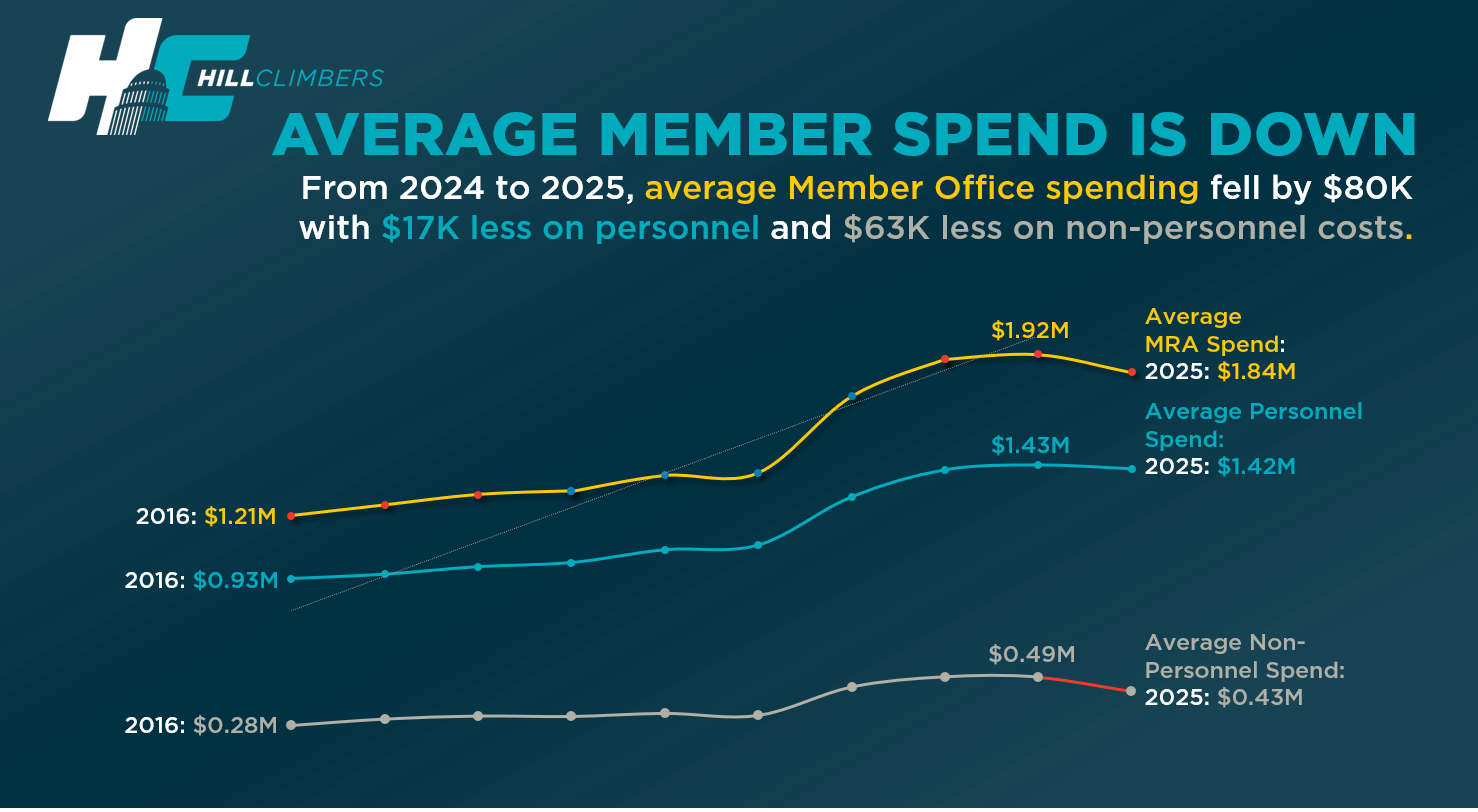
The completed annual data already showed the squeeze in 2025. Average total MRA spending fell from $1.92 million in 2024 to $1.84 million in 2025. That is a decline of about $80,000 per office, or 4.2%.
Average personnel spending fell from $1.43 million in 2024 to $1.42 million in 2025, a decline of about $17,000 per office.
Average non-personnel spending fell from about $490,217 in 2024 to $427,057 in 2025, a decline of about $63,159 per office, or 12.9%.
So the 2026 Q1 data did not come out of nowhere. It follows a completed annual year in which offices already reduced total spending, personnel spending, and non-personnel spending.
Average Member Office Spend Is Down
Annual Spending by Category
The annual category-level data shows how much the 2025 operating squeeze changed the spending picture.
The annual pattern mirrors the Q1 pattern, though less dramatically.
District office rent barely moved. Travel declined modestly. Office expenses and official mail took the larger hits. Personnel spending fell too, but less sharply than the non-personnel categories.
That suggests offices were trying to preserve payroll by cutting operating costs.
But the strategy only worked partially.
Personnel spending still declined.
Staff Pay Is Still the Central Pressure Point
The reason offices try to protect Clerk Hire is obvious: congressional work is staff work.
A Member office depends on people to handle legislation, constituent services, district outreach, communications, scheduling, casework, and operations. HillClimbers’ Member Office Roles page shows how those functions fit together across a typical House office structure.
The payroll pressure reaches every part of that structure.
A Chief of Staff manages the office and helps align staff work with the Member’s priorities. A Legislative Director, Senior Legislative Assistant, or Legislative Assistant handles policy coverage. A Press Secretary or Communications Director manages public-facing communication. A District Director, Field Representative, or Constituent Services Representative/Caseworker helps connect the office to the district.
When offices cut spending, they are not just balancing categories in a spreadsheet. They are deciding how much capacity they can afford.
That is why HillClimbers separates permanent staff analysis from intern-inclusive averages. The public salary data for All House Staff - No Interns gives a cleaner view of the staff base carrying the office’s core workload. The broader All House Staff view is also useful, but interns can distort the compensation picture because they are often temporary, seasonal, and paid differently.
HillClimbers has previously shown that the average House staff salary jumps nearly $10,000 when interns are excluded. That distinction matters here because the MRA squeeze is ultimately about sustaining the permanent workforce.
Cutting Around Payroll Can Only Go So Far
Reducing non-personnel spending can buy time. It cannot solve the underlying problem.
A Member office can spend less on mail. It can delay equipment upgrades. It can limit travel. It can reduce certain office expenses. It can make do with older technology or fewer materials. It can shift more communications online.
But none of those choices is free.
Less travel can reduce district presence. Less mail can reduce constituent communication. Lower office spending can affect technology, supplies, or staff efficiency. District office costs cannot be squeezed indefinitely because rent is not optional.
The pressure eventually returns to payroll.
That appears to be what the 2025 and 2026 Q1 data are showing. Offices reduced non-personnel spending sharply, but average personnel spending still fell.
This is the part that should concern anyone watching congressional capacity. If offices are cutting non-personnel costs and still reducing personnel spending, the easier tradeoffs may already be running out.
This Spending Pattern Matches the Staffing Pattern
The MRA spending data also fits the broader staffing story.
HillClimbers recently showed that House staffing is falling again as flat budgets continue. That analysis found that House staffing excluding interns fell 1.01% from the beginning of February to the end of March in the second session of the 119th Congress.
This article looks at the same pressure from the budget side.
Together, the findings point in the same direction: Member offices are trying to sustain staff capacity after the post-2021 compensation gains, but flat budgets are forcing harder choices.
HillClimbers previously analyzed this broader budget pressure in Congressional Staffing Budget Pressure. The new Q1 spending data sharpens that story because it shows the squeeze inside the MRA itself.
The key point is not just that spending is down. It is that spending is down in a way that reveals the tradeoff structure.
Non-personnel costs are being cut more deeply than personnel costs. But personnel costs are still falling.
That is not a stable long-term model.
2026 Q1 Should Be Compared to Q1, Not Full-Year 2025
The 2026 data should be handled carefully.
Quarter-to-date spending should not be compared directly to full-year annual spending. A Q1 number reflects timing, not a full spending cycle. Payroll cadence, hiring timing, mail schedules, travel patterns, district operations, and office procurement can all shift across quarters.
That is why this article uses two separate comparisons:
- Q1-to-Q1: 2025 Q1 compared with 2026 Q1
- Annual-to-annual: 2024 compared with 2025
The Q1 comparison shows the newest signal. The annual comparison shows the completed-year trend.
Both point in the same direction.
Average office spending is down. Personnel spending is down. Non-personnel spending is down much more sharply.
This Is Not Just an Accounting Story
MRA spending can sound technical. It is not.
It is the operating budget behind the legislative branch’s most visible public-facing offices. It determines how many people an office can employ, how much it can pay them, how much district presence it can maintain, how much mail it can send, how much travel it can support, and how much basic operating capacity it can preserve.
HillClimbers’ broader congressional staffing data shows how staffing patterns have changed over time. The HillClimbers Index provides another way to evaluate office strength, structure, and performance. The spending data adds a crucial layer: how offices are allocating scarce dollars across competing needs.
The 2025 and 2026 Q1 data suggest offices are already making difficult choices.
They are cutting non-personnel costs deeply. They are still reducing personnel spending. And they are doing so after several years when staff pay had finally begun to improve.
The danger is not just that offices spend less.
The danger is that offices lose the operating capacity that makes staff effective.
What the Data Really Shows
The clearest finding is not that offices stopped prioritizing staff pay. The data points the other way.
The clearest finding is that offices appear to be trying to preserve personnel capacity by cutting more deeply elsewhere.
But the 2025 and 2026 Q1 data show the limits of that strategy.
In 2025, average annual total MRA spending fell by about $80,000 per office. Non-personnel spending accounted for about $63,000 of that decline. Personnel spending still fell by about $17,000.
In 2026 Q1, average spending fell by $56,099 compared with 2025 Q1. Non-personnel spending accounted for about $44,927 of that decline. Personnel spending still fell by $11,171.
That is the pattern.
Cut around payroll. Protect staff where possible. But eventually, the pressure reaches staff too.
That is why we can’t keep robbing Peter to pay Paul”
For years, offices have been able to make tradeoffs inside the MRA. Spend less here, preserve more there. Reduce one category, protect another. Cut around payroll to sustain staff.
But when budgets remain flat long enough, the tradeoffs become structural.
Eventually, there is less money for everything.
FAQ
What is the MRA?
The MRA, or Member Representational Allowance, is the operating budget for a U.S. House Member office. It supports staff salaries, travel, district office rent, office expenses, and official mail. HillClimbers explains the broader staffing and MRA structure in its guide to how congressional staffing works.
What is Clerk Hire?
Clerk Hire is the personnel component of the MRA. It reflects money used for staff compensation in House Member offices. In this analysis, Clerk Hire is treated as personnel spending, while travel, district office rent, office expenses, and official mail are grouped as non-personnel spending.
Did House Member office spending fall in 2026 Q1?
Yes. Average House Member office spending fell from $486,924 in 2025 Q1 to $430,825 in 2026 Q1. That is a decline of $56,099 per office, or 11.5%. Personnel spending fell 3.3%, while non-personnel spending fell about 30.3%.
Did House Member office spending also fall in 2025?
Yes. Average annual House Member office spending fell from $1.92 million in 2024 to $1.84 million in 2025. That is a decline of about $80,000 per office, or 4.2%. Personnel spending fell slightly, while non-personnel spending fell much more sharply.
Why did non-personnel spending fall more than personnel spending?
The data suggests offices may have been cutting operating costs to preserve payroll and staffing capacity. Non-personnel categories such as official mail, office expenses, and travel are areas where offices may have more short-term flexibility. But those cuts have limits because district presence, communications, equipment, and operations still matter.
Can House offices move money between MRA categories?
Member offices receive an MRA based on several components, but they generally manage one total office budget. That gives offices flexibility to make tradeoffs across personnel, travel, rent, office expenses, and official mail. Flexibility helps offices adapt, but it also means flat budgets can force harder choices between staff compensation and operating capacity.
Why does this matter for congressional staffing?
Staffing capacity depends on budget capacity. If offices spend less on non-personnel costs and still have to reduce personnel spending, it suggests the MRA squeeze is becoming harder to manage. That can affect hiring, retention, salaries, district service, legislative work, and office operations.
How should readers interpret 2026 QTD or Q1 spending data?
2026 QTD or Q1 data should be compared with prior Q1 periods, not full-year totals. Spending patterns vary across the year because payroll, mail, travel, hiring, and procurement do not occur evenly every quarter. The strongest comparison is 2025 Q1 to 2026 Q1.
Suggested Reading
- Flat Budgets Don’t Mean Flat Staffing Levels
- Congressional Staffing Budget Pressure
- The Average House Staff Salary Jumps Nearly $10,000 Without Interns
- How Big Is a Congressional Office Team and Why It’s Shrinking Again
- Low-Paying Congressional Offices Experience the Highest Staff Turnover