

How Congress Quietly Replaced Part of Its Entry-Level Workforce
For decades, congressional internships were treated as educational experiences.
Students came to Capitol Hill for a semester or summer, answered phones, sorted constituent mail, gave tours, attended hearings, and briefly observed the legislative process before returning to school or moving into other careers.
That is no longer the full story.
New workforce analysis from HillClimbers suggests congressional offices increasingly rely on interns not simply as temporary educational participants, but as a growing source of operational labor capacity inside the House of Representatives itself.
The shift has accelerated rapidly since Congress created a paid intern funding program in 2019.
Today:
- interns have become Congress’s second largest workforce group
- congressional offices maintain elevated intern staffing year-round rather than primarily during summers
- House offices now employ roughly one intern for every five staffers during peak periods
- many traditional permanent entry-level congressional positions continue to decline
Taken together, the data suggests Congress may be quietly restructuring one of the foundational layers of its workforce pipeline.
Congress may be quietly restructuring one of the foundational layers of its workforce pipeline.
The implications extend far beyond internships themselves.
Staffing determines Congress’s institutional capacity.
HillClimbers has also found that House working days have fallen sharply over the past 50 years, meaning Congress may be facing capacity pressure in both staffing structure and legislative time.
And congressional staffing is not merely an HR issue. It shapes whether offices can effectively:
- respond to constituents
- develop policy expertise
- conduct oversight
- manage district operations
- retain institutional knowledge
- train future legislative professionals
In many ways, congressional staffing levels reflect how seriously Congress invests in itself.
And increasingly, Congress appears to be replacing portions of its permanent entry-level workforce structure with temporary labor.
Congressional Staffing Rises Or Falls Based On How Congress Invests In Itself
Congressional offices operate differently than most organizations.
Unlike private companies that can increase revenue, raise prices, attract investment capital, or scale staffing flexibly, congressional offices function within relatively fixed annual budgets called Member Representational Allowances (MRAs).
For readers new to congressional office structure, HillClimbers also explains how House staffing, MRA budgets, and the 18+4 staffing framework work.
MRAs fund nearly every aspect of House office operations, including:
- staff salaries
- district office leases
- travel
- constituent services
- communications operations
- office technology
- equipment
- supplies
- operational expenses
Congressional offices must absorb inflation, rising labor costs, housing costs, district travel expenses, and expanding constituent expectations while operating inside politically constrained appropriations structures.
This budget-sensitive staffing pattern also appears in HillClimbers’ analysis of congressional office size trends, which shows how office teams expanded and contracted as funding conditions changed.
When Congress increases office funding, staffing expands.
When budgets flatten under inflationary pressure, staffing contracts.
The relationship is remarkably visible in House staffing data.

After legislative branch funding increases for the 118th Congress, House staffing levels rose rapidly and surpassed 7,000 daily House office staff for the first time in recent years.
But after budgets later flattened, staffing levels began declining again during legislative year 2025.
This dynamic matters because congressional workloads rarely decline.
Constituent communications continue expanding. Digital engagement expectations continue increasing. Oversight demands remain substantial. District operations have become increasingly complex. Members now face constant social media and rapid-response communications pressure while managing larger information environments than congressional offices historically handled.
Flat budgets do not reduce those expectations.
Instead, offices must determine how to continue operating under growing resource pressure.
Increasingly, internships appear to be one of the mechanisms Congress uses to bridge that gap.
Interns Have Become Congress’s Second Largest Workforce Group
The most dramatic staffing growth inside congressional offices since 2019 has not occurred among legislative staff, district teams, or constituent service operations.
It has occurred among interns.
HillClimbers workforce analysis shows that interns rapidly expanded across House offices after Congress created a House-paid intern funding program in 2019.
Before that program, many congressional internships were unpaid. Participation often depended heavily on whether students could financially afford temporary work in Washington, D.C. without compensation.
The paid intern initiative significantly expanded internship accessibility.
But it also appears to have transformed congressional staffing patterns.
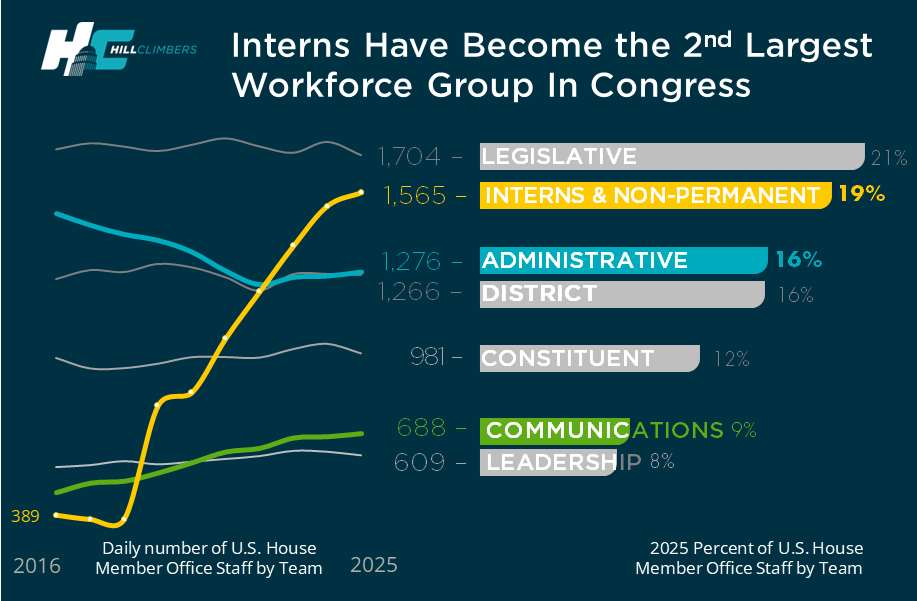
By 2025:
- interns represented approximately 19% of House office workforce capacity
- interns surpassed administrative teams in size, which matters because administrative staff also experienced the sharpest salary decline in House offices during 2025, adding pressure to one of Congress’s traditional support functions.
- interns surpassed district teams in size
- interns surpassed constituent service teams in size
- interns became Congress’s second largest workforce group behind legislative staff
The growth trajectory is striking.
In 2016, interns represented a relatively modest staffing segment compared with core operational teams. By 2025, internship staffing levels rivaled some of the largest permanent workforce categories inside Congress.
Meanwhile:
- communications staffing steadily expanded
- traditional entry-level legislative staffing declined
- multiple permanent operational teams remained relatively flat despite rising workload demands
The workforce structure inside congressional offices is changing.
And it is changing quickly.
Congressional Intern Staffing No Longer Ends After Summer
Historically, congressional internships followed predictable academic cycles.
Summer internship programs dominated congressional intern hiring while spring and fall internships remained comparatively smaller and more temporary.
That seasonal pattern has largely disappeared.
"Intern staffing no longer collapses after summer"
HillClimbers daily staffing analysis shows that congressional offices increasingly maintain elevated internship staffing levels throughout the calendar year.

Summer internship programs remain the largest internship cohort and continue growing rapidly. But beginning around 2023 and 2024, fall and spring internship staffing levels also increased substantially.
Intern staffing no longer collapses after summer.
Instead, internships increasingly function as continuous workforce layers embedded within congressional office operations.
That distinction is important.
A traditional internship model supplements offices temporarily during high-volume periods.
A continuous internship model increasingly becomes part of the office staffing structure itself.
Congressional offices now appear to depend on recurring intern cohorts across nearly the entire year.
House Offices Now Employ Roughly One Intern For Every Five Staffers
The scale of internship growth becomes even clearer when compared directly against permanent staffing levels.
In 2020, House offices averaged roughly:
- one intern for every ten staffers during peak periods
By 2025, that ratio doubled.

During summer periods, House offices now average approximately:
- 2.6 interns for every 10 staff members
Even fall and spring internship staffing levels now approach historical summer internship ratios from only a few years ago.
Importantly, these figures reflect House-paid interns only. They do not include all volunteer interns, fellows, or externally funded placements, meaning the broader internship footprint inside Congress may be even larger than the data shown here.
The implications are difficult to ignore.
Interns are no longer functioning solely as educational participants rotating briefly through congressional offices.
They increasingly represent a meaningful component of Congress’s operational workforce.
Congress Is Hiring Fewer Permanent Entry-Level Staff
At the same time internship staffing expanded, many traditional permanent entry-level congressional positions declined.
The most significant reductions occurred among:
- Staff Assistants
- Legislative Correspondents
- Legislative Aides

Between 2016 and 2025:
- Legislative Correspondent and Legislative Aide staffing declined from roughly 1,170 daily staff to fewer than 1,000
- Staff Assistant staffing also declined substantially
- combined, these traditional entry-level legislative positions declined by approximately 16%
Communications staffing represented one of the few permanent workforce categories that expanded consistently during the same period.
This reflects broader structural changes occurring inside congressional offices:
- social media operations require dedicated staffing
- communications pressure intensified
- digital content production expanded
- members increasingly prioritize media visibility and rapid-response operations
But while communications teams grew, many traditional entry-level legislative pathways contracted.
That trend matters because congressional offices historically developed long-term institutional expertise through those exact positions.
Why Entry-Level Congressional Roles Historically Mattered
For generations, Staff Assistant and Legislative Correspondent roles served as the primary entry point into congressional careers.
These positions often formed the first rung of the Capitol Hill career ladder.
Staff Assistants typically:
- answered phones
- managed front office operations
- coordinated visitor flow
- handled administrative logistics
- supported scheduling
- learned office procedures
- developed relationships across congressional operations
Legislative Correspondents and Legislative Aides often:
- drafted constituent responses
- monitored legislation
- researched policy issues
- handled portfolio assignments
- supported committee work
- developed legislative expertise
Many Chiefs of Staff, Legislative Directors, District Directors, and senior congressional managers began their careers in precisely these types of positions.
Congress historically built institutional knowledge internally through long-term workforce progression.
The decline of permanent entry-level staffing may therefore represent more than a simple labor shift. It may gradually weaken the developmental pipeline Congress has historically relied upon to produce experienced legislative professionals.
Interns Increasingly Perform Operational Work Once Done By Permanent Staff
Modern congressional internships increasingly resemble operational staffing structures rather than purely observational experiences.
Congressional job postings now routinely advertise:
- legislative interns
- communications interns
- district interns
- press interns
- digital interns
- constituent service interns
Many of these internships involve substantive office operations.
Interns may:
- answer constituent communications
- assist with legislative research
- draft memos
- support communications teams
- monitor hearings
- produce social media content
- support district casework operations
- assist with scheduling and office administration
This does not necessarily mean congressional offices are intentionally replacing permanent staff with interns.
Many offices face genuine operational and budgetary constraints.
But the workforce outcome may still produce a similar effect:
a growing share of congressional labor capacity now relies on temporary workers cycling through offices for relatively short periods of time.
Budget Pressure Is Likely Driving Much Of This Shift
Congressional offices face substantial structural cost pressure.
Over the past several years:
- inflation increased labor costs
- Washington housing costs remained extremely high
- district office operations became more expensive
- constituent communication demands intensified
- travel costs increased
- digital communications workloads expanded
- retention challenges worsened, especially in offices where lower staff pay is associated with higher congressional staff turnover
At the same time, congressional office budgets remained politically sensitive and frequently constrained.
Congressional offices cannot simply ignore workload growth.
Instead, they must continually adapt staffing structures within relatively fixed budget environments.
Internship programs offer several operational advantages:
- lower long-term commitment
- semester-based workforce flexibility
- scalable staffing support
- lower compensation costs
- lower benefit obligations
- rapid onboarding cycles
Internships also remain politically and culturally attractive because they continue serving legitimate educational and recruitment functions.
But over time, workforce systems built around temporary labor create different institutional dynamics than systems built around long-term staff development.
Congress May Be Trading Institutional Memory For Workforce Flexibility
Congress depends heavily on accumulated expertise.
That concern connects directly to HillClimbers’ finding that institutional knowledge in Congress is increasingly held by staff as member tenure declines and staff experience rises.
Legislative drafting, appropriations work, constituent services, committee operations, oversight, parliamentary procedures, district coordination, and office management all require experience developed over time.
Historically, Congress cultivated that expertise internally.
Young staffers entered through entry-level positions, developed specialized knowledge, advanced into larger roles, and gradually built institutional continuity inside offices and committees.
As permanent entry-level staffing narrows and internship reliance expands, Congress may increasingly face challenges related to:
- institutional memory
- long-term staff retention
- workforce continuity
- legislative expertise development
- operational stability
- training burden
- managerial turnover
Temporary labor structures create constant onboarding cycles.
Every semester, offices must train new interns, rebuild workflow familiarity, and transfer operational knowledge repeatedly.
That process consumes time and managerial bandwidth that permanent staff historically retained internally.
Internships remain valuable and important opportunities. They continue introducing thousands of students and young professionals to public service.
But internships are temporary by design.
HillClimbers analysis shows that since 2009, only approximately 13% of interns ultimately remained in or returned to House employment long term.
If a growing share of congressional workforce capacity relies on continuously rotating temporary labor, Congress may gradually weaken one of the very systems that historically sustained institutional expertise inside the legislative branch.
Congress may increasingly be trading institutional memory for workforce flexibility.
Congress’s Staffing Structure Shapes Congress’s Capacity
Congressional staffing is ultimately about more than employment numbers.
Staffing determines institutional capability.
The number of experienced legislative staff inside congressional offices directly affects Congress’s ability to:
- process legislation
- conduct oversight
- respond to constituents
- retain expertise
- manage district operations
- sustain long-term policy knowledge
- operate independently as a co-equal branch of government
As internship staffing expands and permanent entry-level roles decline, Congress may be entering a new phase in how its workforce operates, develops expertise, and sustains itself over time.
The long-term effects of that transition may not become fully visible for years.
But the workforce shift itself is already happening.
Quietly, steadily, and at significant scale.
About The Data
This same workforce classification system powers the HillClimbers Index, which tracks staffing stability, retention, and office workforce patterns across the House.
HillClimbers standardizes thousands of congressional job titles into functional workforce teams including:
- Legislative
- Administrative
- District
- Communications
- Leadership
- Constituent Services
- Interns & Non-Permanent Staff
To avoid double counting staff who hold multiple roles, HillClimbers uses a “single role plus” methodology that proportionally distributes shared-role assignments across workforce categories while preserving total staffing counts.
The platform tracks daily staffing assignments across House offices, enabling long-term analysis of congressional workforce structure, staffing trends, institutional capacity, and career pipeline shifts.
Explore More Congressional Workforce Insights
HillClimbers provides:
- congressional staffing analysis
- Capitol Hill salary data
- House and Senate job openings
- congressional career pathway analysis
- workforce retention research
- office staffing intelligence
- legislative workforce trend analysis
- role-level compensation insights
FAQ Section
Why are congressional internships growing so rapidly?
Congressional internship staffing expanded significantly after the House established a paid intern funding initiative in 2019. The program increased internship accessibility while allowing offices to expand staffing support under constrained budget conditions.
How many interns work in Congress today?
HillClimbers workforce analysis found interns represented roughly 19% of House office staffing capacity by 2025, making interns Congress’s second largest workforce group behind legislative staff.
Are congressional internships still mostly seasonal?
Not entirely. HillClimbers daily staffing analysis shows internship staffing now remains elevated throughout spring, summer, and fall cycles rather than dropping sharply after summer as it traditionally did.
How many interns do House offices employ?
By 2025, House offices averaged approximately one paid intern for every five staff members during the year, with summer periods reaching roughly 2.6 interns for every 10 staff members.
Are permanent entry-level congressional jobs declining?
Yes. Traditional entry-level roles such as Staff Assistant, Legislative Correspondent, and Legislative Aide positions declined significantly between 2016 and 2025 according to HillClimbers workforce analysis.
Why do entry-level congressional positions matter?
These roles historically formed Congress’s long-term expertise pipeline. Many Chiefs of Staff, Legislative Directors, committee staff, and senior congressional professionals originally began their careers in these entry-level positions.
Are interns replacing permanent congressional staff?
The data does not necessarily prove intentional replacement. However, internship staffing expanded rapidly during the same period many permanent entry-level staffing roles declined, creating a workforce structure that relies more heavily on temporary labor capacity.
What do congressional interns actually do?
Modern congressional interns frequently support constituent communications, legislative research, scheduling operations, digital communications, social media production, administrative coordination, and district office operations.
Why do congressional offices rely heavily on interns?
Congressional offices operate within relatively fixed annual budgets while facing growing workload pressure from communications demands, constituent services, district operations, and rising labor costs. Internships provide scalable staffing support with lower long-term obligations.
Why does congressional workforce structure matter?
Congressional staffing determines institutional capacity. Workforce structure affects Congress’s ability to process legislation, conduct oversight, retain expertise, manage constituent services, and sustain long-term institutional knowledge.
What is institutional knowledge in Congress?
Institutional knowledge refers to expertise developed over time through congressional experience, including legislative procedure, appropriations, committee operations, constituent services, district coordination, and office management practices.
Do most congressional interns stay on Capitol Hill long term?
No. HillClimbers analysis found that only approximately 13% of interns ultimately remained in or returned to long-term House employment after their internship experience.
Why might relying heavily on temporary staff create long-term challenges?
Temporary workforce structures create recurring onboarding and knowledge-transfer cycles. Offices must repeatedly recruit, train, and integrate new intern cohorts rather than retaining operational familiarity through long-term permanent staffing structures.
What does HillClimbers mean by “Congress may be trading institutional memory for workforce flexibility”?
The phrase refers to the possibility that expanding temporary staffing structures provide operational flexibility under constrained budgets while potentially weakening the long-term workforce development systems that historically preserved congressional expertise and continuity.
How does HillClimbers analyze congressional staffing trends?
HillClimbers standardizes thousands of congressional job titles into functional workforce categories and tracks daily staffing assignments across House offices to analyze long-term workforce structure, staffing trends, institutional capacity, and career pipeline changes.