
The Highest-Paid Non-Leader Team Still Averages About $75,000
Congressional policymaking does not happen with Members alone.
Behind every legislative agenda is a staff operation researching issues, evaluating proposals, meeting with stakeholders, preparing Members for hearings and votes, responding to constituent concerns, and helping turn policy priorities into legislation.
A Legislative Assistant advises a Member on specific policy areas, conducts research, and assists in developing legislative initiatives. HillClimbers
A Senior Legislative Assistant typically handles more complex or high-profile policy portfolios and may help guide junior legislative staff. Its current title mix includes Policy Advisor, Legislative Counsel, National Security Advisor, Health Policy Advisor, Counsel, and Senior Counsel. HillClimbers
A Legislative Correspondent/Aide helps ensure constituent views on legislation reach the Member while often serving as an early rung on the policy career ladder. HillClimbers
These are some of the people helping Congress decide what the federal government should do.
Among permanent House staff below the office and functional-leader level, they are also the highest-paid functional team.
Their average salary through June 30, 2026:
$75,444.
The highest-paid non-leader functional team in the House still averages just $75,444.
That is the more important finding in this update.
The story is not simply that legislative staff earn more than their congressional peers.
It is what "high-paid" means inside Congress.
Legislative Staff Pay Looks Different Below the Leadership Level
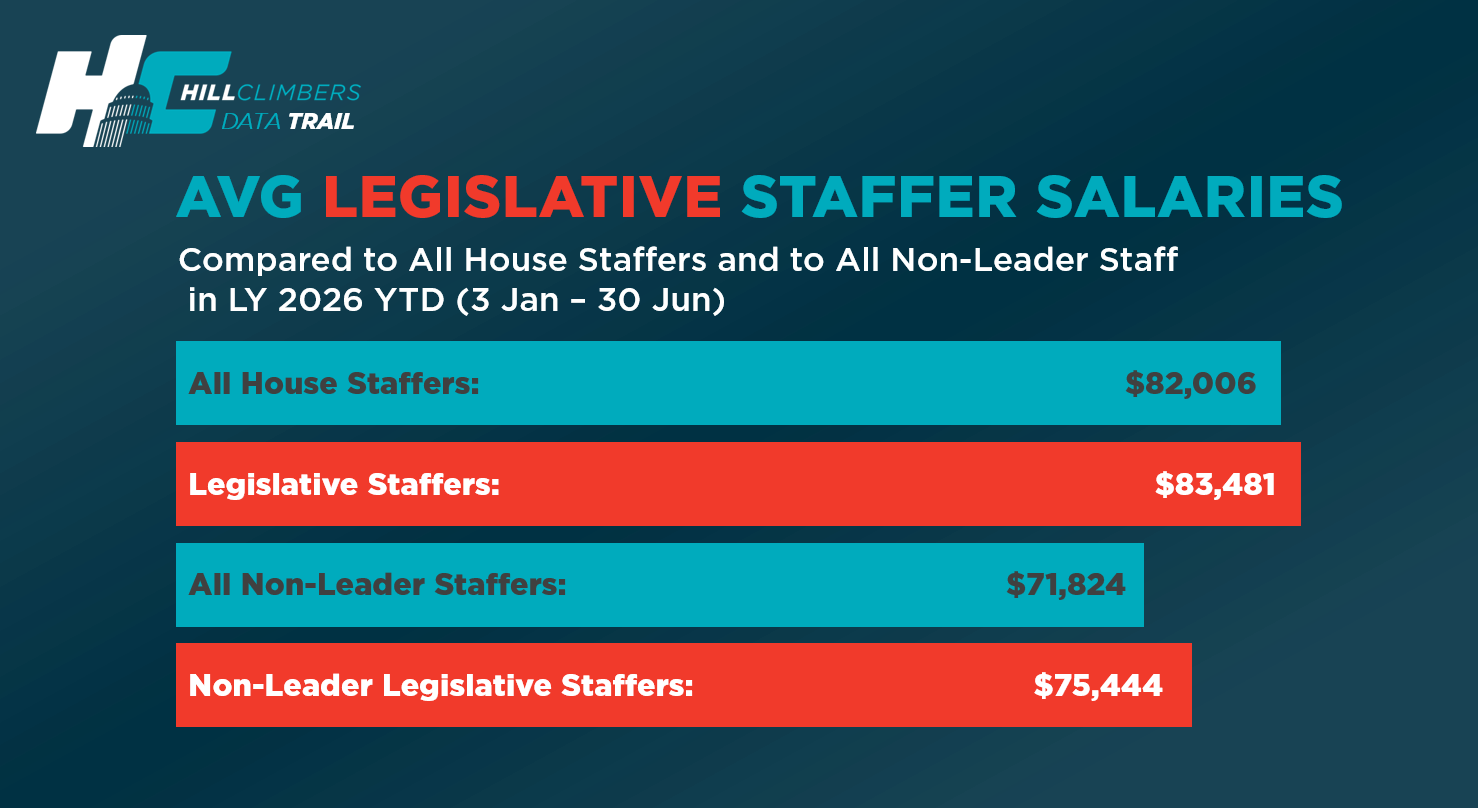
House legislative staff averaged $83,481 through June 30, 2026, compared with $82,006 for All House Staff excluding interns. Among staff below the functional-leader level, legislative staff averaged $75,444 compared with $71,824 for all non-leader House staff.
The full legislative team averaged $83,481.
That is only $1,475, or 1.8%, above the $82,006 average for All House Staff excluding interns, using HillClimbers' revised person-level Q2 methodology. HillClimbers
Remove the Legislative Director and compare the staff working below the functional-leader level, however, and the picture changes.
Non-leader legislative staff averaged $75,444.
All non-leader House staff averaged $71,824.
That is a $3,620 difference, or approximately 5.0%.
What Congress Is Asking a $75,444 Legislative Staffer to Do
The legislative function covers a wide range of experience.
HillClimbers' Member Office Roles framework places four primary standardized roles on the legislative team:
The Legislative Director manages the policy operation and is classified as its functional leader. HillClimbers therefore removes the LD when calculating the non-leader legislative benchmark. HillClimbers
Below that level sit staff handling issues that can include national security, health care, taxes, energy, education, technology, agriculture, transportation, environmental policy, appropriations, and countless other areas.
Not every legislative employee drafts statutory language every day.
But collectively, these are employees Congress relies on to understand complex policy, advise elected Members, track legislation, engage experts and stakeholders, and help develop legislative initiatives.
That expertise takes time to build.
And once it is built, it is valuable well beyond Capitol Hill.
Legislative Staff Already Sit Near the Top Inside Congress
Across all five major Member office functions, legislative staff are already near the top of the salary structure.
Through Q2 2026:
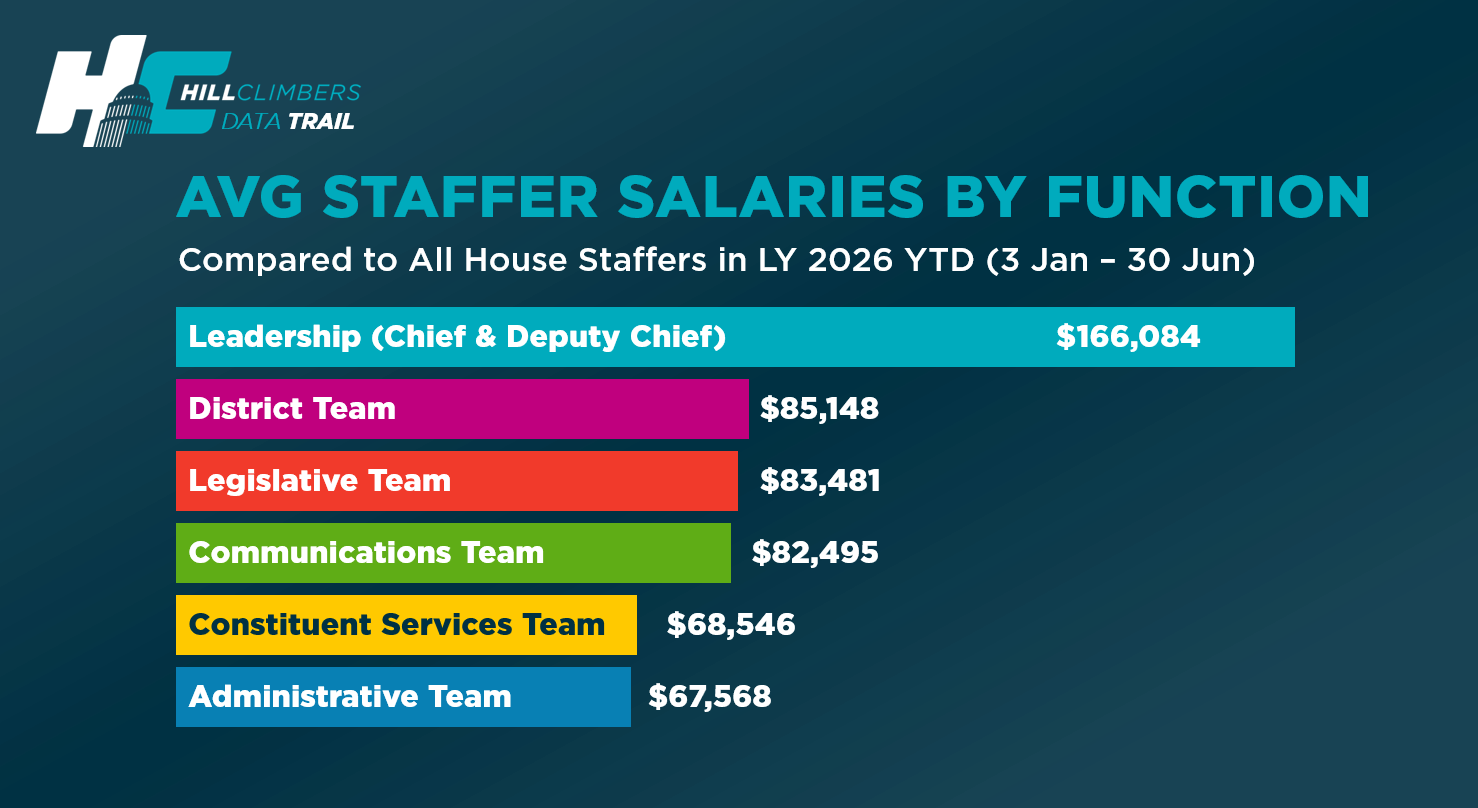
- District Team: $85,148
- Legislative Team: $83,481
- Communications Team: $82,495
- Constituent Services Team: $68,546
- Administrative Team: $67,568
Legislative staff rank second overall, behind district staff and slightly ahead of communications.
That broadly continues the hierarchy HillClimbers found in the earlier legislative salary analysis, although the old and new figures should not be treated as a clean year-over-year salary series because the underlying methodology has changed. HillClimbers
Legislative Staff Sit Near the Top of the House Salary Structure
The overall comparison is useful.
But functional leaders affect those averages differently.
A Legislative Director, District Director, Communications Director, Director of Constituent Services, and Director of Operations sit at very different points in their respective teams.
Removing them lets us ask a cleaner question:
How are the people working below the functional-leader level paid across the different parts of a Member office?
Remove Functional Leaders and Legislative Staff Move to the Top
For this updated five-part salary series, HillClimbers uses one common definition of a non-leader staffer.
The population excludes:
- Chiefs of Staff
- Deputy Chiefs of Staff
- Legislative Directors
- Press Secretaries/Communications Directors
- District Directors
- Directors of Constituent Services/Casework
- Directors of Operations
- Paid interns
- Part-time employees
- Temporary staff
Everyone else in the five permanent functional teams remains in the benchmark.
That gives each article the same $71,824 All Non-Leader Staff average.
Unlike the previous series, the function being analyzed is included in that benchmark. That makes the denominator consistent from one team to another.
Remove Functional Leaders and Legislative Staff Move to the Top
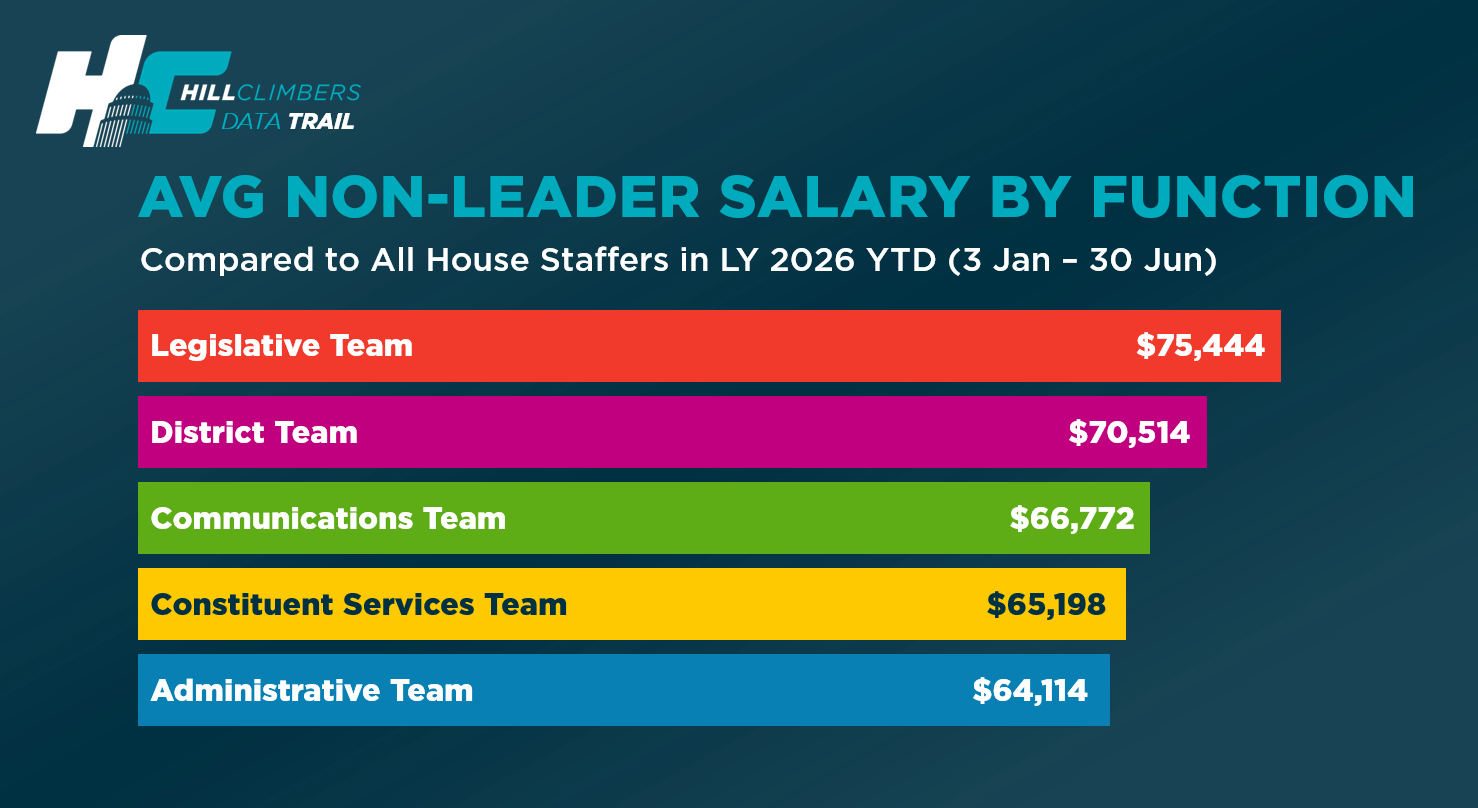
The differences are substantial.
Non-leader legislative staff averaged $4,930 more than district staff.
They averaged $8,672 more than communications staff.
They averaged $10,246 more than constituent services staff.
And they averaged $11,330 more than administrative staff.
Within a House Member office, legislative staff appear relatively well compensated.
Then you leave the Capitol Hill labor market.
Outside Congress, $75,444 Looks Very Different
Congressional legislative staff do not compete for jobs only against other congressional employees.
The same policy, research, writing, analytical, legislative, stakeholder-management, and government-process skills are used throughout Washington.
That includes trade associations, advocacy organizations, nonprofits, consulting firms, corporations, government-relations practices, and law-firm public-policy teams.
To put the $75,444 House legislative benchmark in context, HillClimbers reviewed five current Glassdoor salary pages for adjacent Washington, D.C. job titles.
Glassdoor currently estimates these total-pay ranges:
- Policy Advisor: $100,000 to $178,000
- Public Policy Advisor: $89,000 to $163,000
- Government Relations Associate: $65,000 to $105,000
- Government Affairs Associate: $94,000 to $169,000
- Public Policy Associate: $81,000 to $137,000
The Glassdoor D.C. Policy Advisor page reports a $100,000 to $178,000 total-pay range. Glassdoor
Government Affairs Associates are estimated at $94,000 to $169,000, while Government Relations Associates are estimated at $65,000 to $105,000. Glassdoor
Those are not perfect job-for-job comparisons.
They do not need to be to make the labor-market point.
Among the four Glassdoor benchmarks in this group with submitted salary data, three have estimated total-pay ranges that begin above $75,444.
The lower end of the Policy Advisor range is $24,556 higher than the average non-leader House legislative salary.
The Government Affairs Associate range starts $18,556 higher.
The Public Policy Associate range starts $5,556 higher.
Only Government Relations Associate has a range that begins below the House legislative average.
A legislative staffer can be among the better-paid employees in Congress and still face a much richer market for similar skills outside it.
These Are Market Benchmarks, Not an Apples-to-Apples Pay Gap
There is an important limitation.
HillClimbers is measuring salary.
The Glassdoor figures are estimated total-pay ranges, which may include additional compensation beyond base salary.
The job populations are also broader than Congress. A Policy Advisor at a federal agency, nonprofit, association, consulting firm, or corporation is not doing exactly the same work as a House Legislative Assistant.
Experience levels differ.
Job responsibilities differ.
Benefits differ.
And the Glassdoor samples vary considerably by title.
That means the article should not claim that a congressional staffer making $75,444 would automatically make $100,000, $125,000, or $150,000 simply by leaving the Hill.
The evidence does not support that.
What the comparison does show is the pay environment surrounding congressional policy work.
The $75,444 average sits below the bottom of several adjacent D.C. total-pay ranges.
That matters for recruitment and retention even if no one comparison provides a precise private-sector premium.
One of the five Glassdoor pages also deserves a specific caveat. The Public Policy Advisor page displayed an $89,000 to $163,000 range, but showed zero salary submissions when HillClimbers reviewed it. We therefore include that figure only as directional context and exclude it from the stronger three-of-four comparison.
That is why the outside benchmark should be read as market context, not a precise calculation of congressional underpayment.
Congress Creates Expertise That the Rest of Washington Can Buy
The compensation challenge becomes sharper as legislative staff gain experience.
A junior legislative employee may begin by tracking issues, managing correspondence, or supporting a policy portfolio.
Over time, that person can become the office expert on a highly specialized area.
HillClimbers' current Senior Legislative Assistant role data includes titles such as Policy Advisor, Senior Policy Advisor, Legislative Counsel, National Security Advisor, Health Policy Advisor, Counsel, and Senior Counsel. HillClimbers
Those titles tell us something important.
The skills Congress develops are portable.
A staffer who knows a federal policy area, understands congressional procedure, writes clearly, has relationships across the Hill and executive branch, and knows how legislation actually moves through Congress possesses expertise that can be useful to many other employers.
Public service, mission, influence, colleagues, and commitment to an issue can all keep people on Capitol Hill.
Salary is not the only reason someone chooses congressional work.
But outside opportunities do not disappear because someone values public service.
Congress is building human capital in a labor market where other employers can often pay considerably more for it.
That Makes Retention a Congressional Capacity Issue
Compensation matters because institutional expertise is cumulative.
HillClimbers has found that House staff experience has risen while Member tenure has fallen. Average House staff experience increased from 2.3 years in 2018 to 3.6 years in 2025, while average Member tenure declined over a longer period. HillClimbers
That suggests more institutional continuity may increasingly reside with staff.
HillClimbers has also found that lower-paying congressional offices experience higher staff turnover. Offices averaging below $69,000 in staff pay experienced turnover reaching 29.3%, while turnover was lower and more stable above that level. The analysis does not establish salary as the sole cause of turnover, but compensation is clearly part of the retention picture. HillClimbers
For legislative teams, the institutional cost of turnover can be larger than the vacancy itself.
The office can lose policy expertise.
It can lose relationships with agencies and stakeholders.
A new employee has to learn the portfolio.
Legislative history and context have to be transferred.
Other staff may have to absorb the work while the position is vacant.
Congressional capacity is staff capacity.
And policy capacity depends heavily on retaining people long enough to become experts.
Flat Budgets Make the Competition Harder
This salary story is also unfolding while Member office budgets are under renewed pressure.
HillClimbers' Q1 Member office spending analysis found that average office spending fell 11.5% from 2025 Q1 to 2026 Q1.
Personnel spending fell 3.3%.
Non-personnel spending fell 30.3%.
Offices appear to have cut more deeply outside payroll in an effort to preserve staff capacity, but personnel spending still declined. HillClimbers
That pattern is consistent with the broader workforce picture.
HillClimbers' revised 2026 Q2 staffing analysis found House Member offices averaging 6,827 non-intern staff per day, 1,020 fewer than in the comparable 2010 period. HillClimbers
The subsequent daily staffing update showed that the staffing weakness identified earlier in 2026 persisted through Q2. HillClimbers
And earlier HillClimbers research showed the broader pattern: House staffing expanded after office funding increased and weakened again as budgets flattened. HillClimbers
The reason is straightforward.
A nominally flat Member Representational Allowance does not preserve the same operating capacity when costs rise.
HillClimbers' guide to congressional staffing explains how the MRA must support staff compensation alongside rent, travel, technology, official communications, and other office expenses.
If those costs rise while the budget does not, the purchasing power of the office falls.
That means less room for raises.
Less room for hiring.
And less room to compete when an experienced policy staffer has substantially better-paid options elsewhere.
Why the Numbers Changed From the Earlier Legislative Article
This article updates HillClimbers' May analysis, House Legislative Staff Salaries Look Average Until Compared With Their Peers.
Readers should not compare the earlier numbers directly with the new Q2 figures as though they represent simple year-over-year salary changes.
The methodology has changed.
The earlier analysis reported:
- Legislative staff: $86,020
- All House Staff excluding interns: $85,847
- Non-legislative, non-leadership peer staff: $78,563
The new analysis reports:
- Legislative staff: $83,481
- All House Staff excluding interns: $82,006
- All non-leader staff: $71,824
- Non-leader legislative staff: $75,444
The most important change is the population definition.
The previous peer benchmark included Deputy Chiefs of Staff within its non-leadership population.
The new methodology classifies Chiefs and Deputy Chiefs as leadership.
It also removes the leader of each major function: the Legislative Director, Press Secretary/Communications Director, District Director, Director of Constituent Services/Casework, and Director of Operations.
Non-permanent staff, including interns, part-time employees, and temporary employees, are excluded.
The highlighted function is now included in the All Non-Leader Staff benchmark as well.
That means every article in this new five-part series can use exactly the same $71,824 denominator.
HillClimbers also rebuilt its broader House-wide measures around the person-level methodology introduced in the 2026 Q2 staffing analysis. A staffer holding multiple roles counts once when calculating institution-wide workforce measures rather than once for every role appearance. HillClimbers
So the new figures are the better benchmark going forward.
The Ranking Is Interesting. The $75,444 Is More Important.
Legislative staff are the highest-paid non-leader functional team in the House.
That is a useful fact.
But it should not be the takeaway.
The more revealing number is $75,444.
That is what the highest average among the five non-leader functions looks like.
And it exists inside a Washington labor market where adjacent policy and government-affairs jobs commonly carry much higher reported pay ranges.
Congress does not have to match every outside salary.
A Member office is not a lobbying shop, consulting firm, trade association, corporation, or law firm.
Public service is also not reducible to compensation.
But Congress does have to compete for people.
It has to recruit them.
It has to train them.
And if it wants to preserve the expertise they develop, it has to give them a financially viable reason to stay.
Congress can pay its legislative staff more than their House peers and still underinvest in the policy expertise it depends on.
That is the capacity question behind the salary number.
This Is the First Update in a Five-Part Series
This legislative analysis is the first of five updated HillClimbers Q2 salary articles.
The next four will examine:
- District staff
- Communications staff
- Constituent services staff
- Administrative staff
The earlier versions remain useful context, including the analyses of district staff salaries, communications staff salaries, constituent services salaries, and administrative staff salaries. HillClimbers
Once all five updates are complete, HillClimbers will bring them together into a special report on how compensation is distributed across the modern House Member office.
FAQ
What is the average salary for House legislative staff in 2026?
The full House legislative team averaged $83,481 through June 30, 2026. Among legislative staff below the functional-leader level, the average was $75,444.
Are legislative staff the highest-paid House staff team?
Not when functional leaders are included. District staff averaged $85,148, compared with $83,481 for legislative staff. Among non-leader staff, however, legislative staff had the highest average at $75,444.
How much more do legislative staff make than other non-leader House staff?
All non-leader House staff averaged $71,824 through Q2 2026. Non-leader legislative staff averaged $75,444, which is $3,620 or approximately 5.0% higher.
How does congressional legislative pay compare with similar jobs in Washington?
Glassdoor estimates D.C. total pay at $100,000 to $178,000 for Policy Advisors, $94,000 to $169,000 for Government Affairs Associates, and $65,000 to $105,000 for Government Relations Associates. HillClimbers' non-leader legislative salary average is $75,444. These are adjacent labor-market benchmarks rather than exact job equivalents, and the Glassdoor figures represent total pay rather than salary alone. Glassdoor
Does that mean every congressional legislative staffer could make more outside Congress?
No. The data does not support that conclusion. Salaries vary by experience, employer, specialty, education, credentials, and job responsibilities. The comparison shows that congressional policy employees operate within a broader Washington labor market containing many substantially higher-paid opportunities for related skills.
What roles are included in the House legislative team?
HillClimbers' core legislative roles are Legislative Director, Senior Legislative Assistant, Legislative Assistant, and Legislative Correspondent/Aide.
Is $75,444 the average Legislative Assistant salary?
No. It is the average for the combined non-leader legislative function. Legislative Assistants, Senior Legislative Assistants, Legislative Correspondents/Aides, counsels, policy advisors, and other legislative titles can have different compensation levels. For an individual job offer, the relevant role-specific benchmark is more useful than the team average.
Why did the non-leader benchmark fall from $78,563 to $71,824?
It did not necessarily "fall." The population changed. The earlier analysis included Deputy Chiefs in the comparison and excluded the highlighted legislative function from the peer group. The new methodology removes office and functional leaders and uses one common All Non-Leader Staff population across all five functional articles.
Why does congressional legislative pay matter?
Legislative staff accumulate policy knowledge, procedural experience, and institutional relationships that offices rely on. HillClimbers data shows staff experience has been rising while Member tenure has declined, and lower-paying congressional offices have experienced higher turnover. Compensation therefore affects more than individual earnings. It can affect retention and institutional capacity. HillClimbers
Where can I find current legislative jobs on Capitol Hill?
Current House and Senate openings are available on the HillClimbers Congressional Jobs Board.
Suggested Reading
- House Legislative Staff Salaries Look Average Until Compared With Their Peers
- The House Is Running With 1,020 Fewer Staff Than It Did in 2010
- The House Staffing Drop Is No Longer Just an Early-Year Dip
- House Offices Are Running Out of Things to Cut
- Flat Budgets in 2026 Are Hitting House Staffers Even Harder
- Low-Paying Congressional Offices Experience the Highest Staff Turnover
- Institutional Knowledge in Congress Is Increasingly Held by Staff
- The Average House Staff Salary Jumps Nearly $10,000 Without Interns
Explore Related HillClimbers Tools
- Explore Member Office Roles
- Legislative Director
- Senior Legislative Assistant
- Legislative Assistant
- Legislative Correspondent/Aide
- All House Staff, Excluding Interns
- Explore Congressional Staffing Data
- Learn How Congressional Staffing Works
- Explore the Congressional Dataset
- View Current Congressional Jobs